
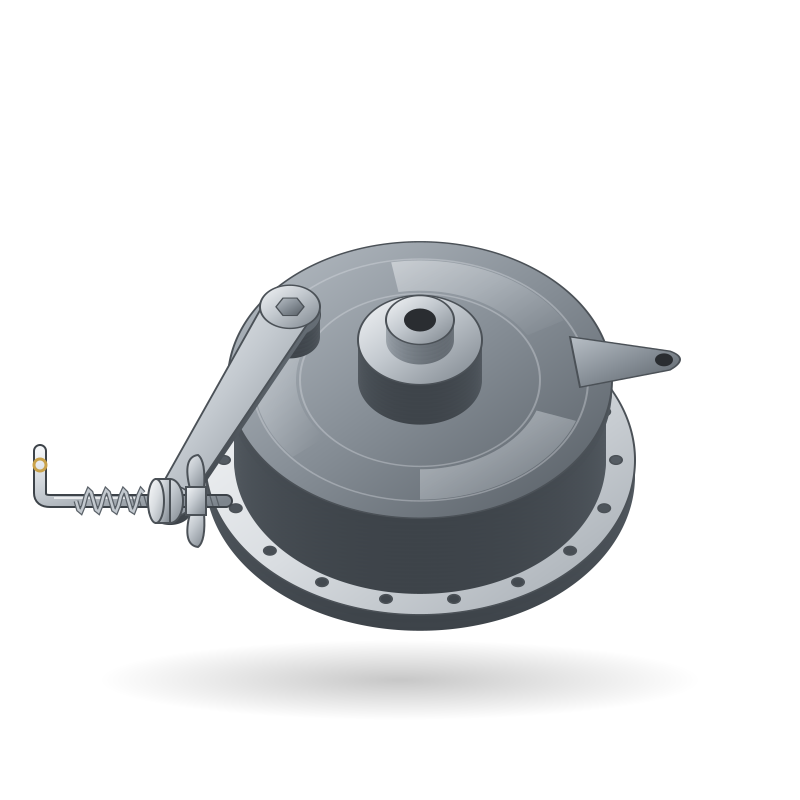
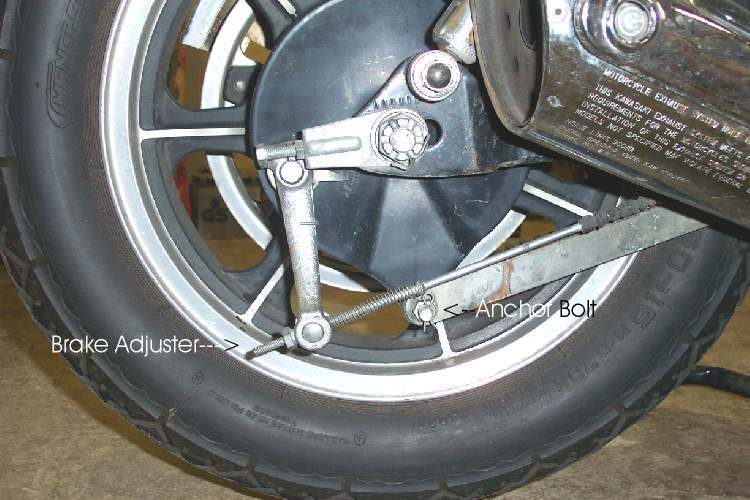
The rear brake is worked by the pedal by your right foot, or by the left lever on scooters and some step-throughs. It is either a drum brake inside the rear hub, pulled by a rod or cable, or a disc brake with its own master cylinder, hose and caliper.
What it does
The rear brake steadies the bike and helps it slow down, especially at low speed and on loose ground. Because weight moves forward when braking, the rear wheel locks more easily than the front. On a drum brake the pedal turns a cam that spreads two shoes against the inside of the drum. On a disc brake the pedal pushes a master cylinder that clamps pads on a disc. On bikes with CBS, the pedal also applies part of the front brake.
Signs it is worn or failing
- Pedal goes down too far: Rear brake pedal travels too far.
- Weak drum brake: Drum brake is weak. Noisy drum: Drum brake squeaks or grinds.
- Wheel drags or brake light stays on: Brake drag.
- Rear locks too easily: Wheel locks too easily.
- Disc rear: same signs as the front, see Spongy brake.
When to replace it
Replace the wearing parts: Drum brake shoes, Brake pads, Brake cable and rod, Brake fluid, the Brake disc or the rear Brake master cylinder.
What to match when buying
- Check which type your bike has: drum (round hub with an arm and rod) or disc (caliper on the swingarm).
- Match make, model and year, and note whether the bike has CBS or ABS.
Fitting notes
- Drum: Adjust a drum brake, Service a drum brake.
- Pedal height and free play: Adjust the rear brake pedal.
- After adjusting, spin the wheel and check it turns freely and the brake light works.
Reference (K-Light 125)
| Item | Value | PDF page |
|---|---|---|
| Rear brake | Hydraulic disc, 240 mm, 2-piston caliper | 107, 109 |
| Rear pedal free play | 20 to 30 mm | 62 |
| Pushrod to rear master piston clearance | 0 to 0.2 mm | 116 |