
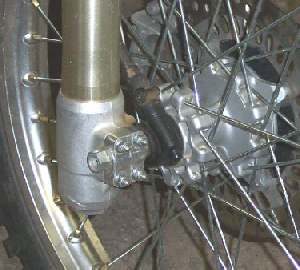
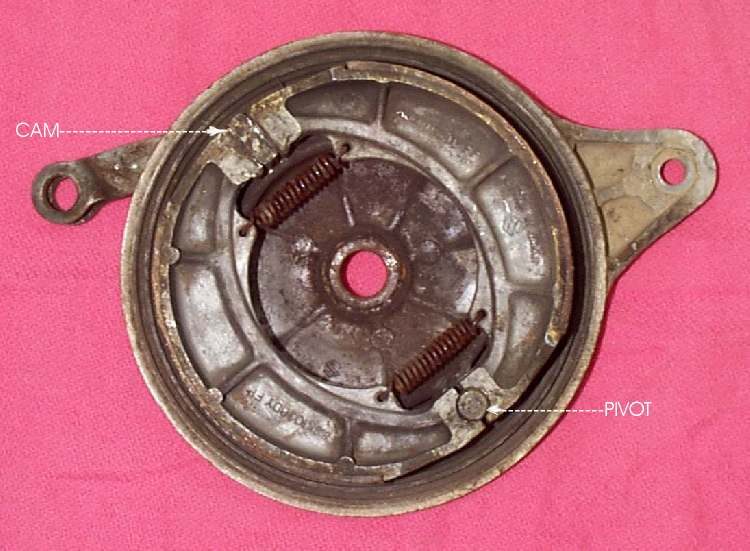
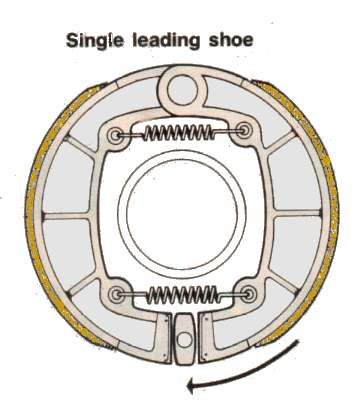
A drum brake that needs a lot of force or travel and still slows the bike poorly. In a drum brake, a cam spreads two shoes against the inside of the drum. Weak braking comes from: shoes needing adjustment, worn or glazed shoes, oil or grease on the linings, water in the drum, a stiff cable or cam, or a cam that has turned so far it no longer pushes well.
Is it safe to ride?
No, until it is adjusted or serviced. A weak rear drum means you are relying on the front alone.
Quick checks first
- Measure free play at the lever or pedal and compare with your manual.
- Look at the wear indicator pointer on the brake arm with the brake applied: is it past the end of the mark?
- Has the bike just been through deep water or washed? Brake gently a few times to dry it.
- Did you just adjust the chain? Moving the rear wheel changes the brake rod length.
- A twin leading shoe brake has two cams. If they are not adjusted so each shoe touches the drum at the same time, braking is weaker than a single cam brake.
- A cam shaft rusted tight, or lining that has come unglued from the shoe, also gives weak or sticking brakes. Both need the wheel and shoes off.
- After refitting the wheel, spin it, press the brake on hard and hold it, then tighten the axle. This centres the shoes.
Diagnose it step by step
1Is the free play more than your manual allows?
- Yes: Adjust a drum brake, then test.
- No: go to step 2.
2After adjusting, is the wear pointer past its mark or the adjuster at the end of its thread?
- Yes: the shoes are worn out. Service a drum brake.
- No: go to step 3.
3With the brake applied, is the brake arm past a right angle to the rod or cable?
- Yes: the cam has lost leverage; worn shoes or drum. Service a drum brake.
- No: go to step 4.
4Is the cable or lever stiff, or slow to return?
- Yes: much of your effort is lost in friction. Lubricate control cables; replace a frayed cable. See A control cable is frayed or stiff.
- No: go to step 5.
5Is there oil or grease near the hub (leaking hub seal, chain lube, over-greased cam)?
- Yes: oily shoes must be replaced, and the leak fixed. Service a drum brake.
- No: go to step 6.
6When serviced, are the shoes glazed or the drum glazed, cracked or worn beyond its maximum diameter?
- Glazed only: clean with fine abrasive paper and refit.
- Worn shoes: replace as a pair.
- Cracked or oversize drum: replace the hub.
7Does it get weak only on long hills?
- Yes: see Brakes get weaker when hot.
Causes, most likely first
| Cause | How to confirm | Fix |
|---|---|---|
| Needs adjustment | Too much free play | Adjust a drum brake |
| Wet drum | After water; recovers | Dry with gentle brake use |
| Stiff cable or cam | Heavy lever; slow return | Lubricate control cables |
| Worn shoes | Pointer past mark; adjuster at end | Service a drum brake |
| Oily linings | Oil inside drum | New shoes, fix leak |
| Glazed shoes or drum | Shiny hard surfaces | Clean or replace |
| Worn or cracked drum | Over maximum diameter; cracks | Replace hub |