
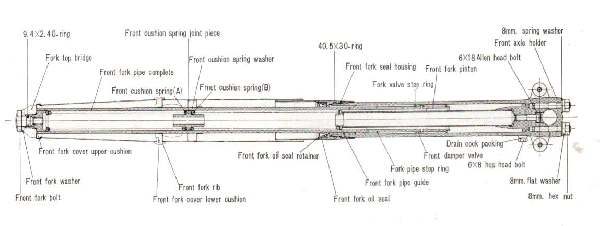
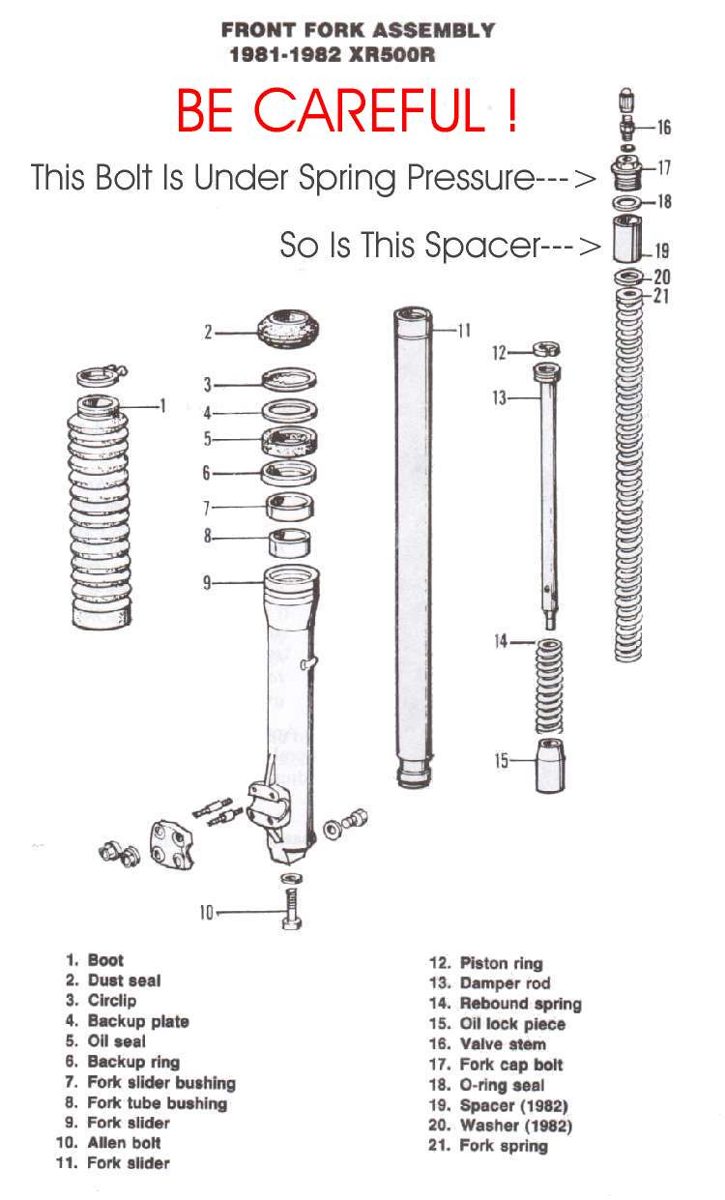
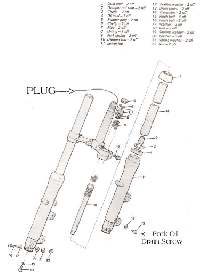
On a bump or under hard braking the forks compress all the way and stop with a hard clunk. The front may also dive a long way when you brake, or keep bouncing after a bump. The fork has too little oil (from a leak), old thin oil, tired springs, or it is carrying more weight than it was set up for. The spring holds the bike up; the oil slows the movement. Low or old oil means little damping, and tired springs mean the fork sits lower and has less travel left.
Is it safe to ride?
Ride with care at lower speed. Hard bottoming under braking can upset the bike. If one leg leaks heavily or oil is on the brake, do not ride.
Quick checks first
- Look for oil on the fork tubes and legs.
- Hold the front brake and push the bars down hard: does it go down too easily, or knock at the bottom?
- Push down and let go: does it bounce more than once?
- Is the bike carrying heavy loads on the front (bags on the bars, a front rack)?
- A spacer on top of a sagged spring, or thicker oil, can firm up the front end. See Fit a fork spring spacer and Set the fork oil level.
Diagnose it step by step
1Is either fork leg leaking?
- Yes: the leg has lost oil. Go to Oil leaking from a fork leg.
- No: go to step 2.
2Does the front bounce more than once after you push down and let go?
- Yes: damping is weak: low, old or wrong-grade oil. Replace fork oil and seals.
- No: go to step 3.
3Does the front sit lower than before, or does the fork use almost all its travel just with the rider on board?
- Yes: the springs are tired. Check with Measure suspension sag. The workshop measures spring free length (K-Light 125: 300 mm new, replace below 295 mm).
- No: go to step 4.
4Do both legs feel the same?
- No: one leg may have less oil, a broken spring or a damaged damper. Workshop: Replace fork oil and seals.
- Yes: go to step 5.
5Is the load heavier than the bike was built for, or is the front tyre soft?
- Yes: reduce the load and set the tyre pressure with Check tyre pressure. A soft rear can also tip weight forward; see Rear sits too low.
- No: have a workshop check the oil amount and grade is exactly as the manual says. Wrong amount or grade is common after a cheap service.
Causes, most likely first
| Cause | How to confirm | Fix |
|---|---|---|
| Oil lost through leaking seals | Oil on tubes | Replace fork oil and seals |
| Old or wrong oil | Bounces; never changed | Replace fork oil and seals |
| Tired springs | Sits low; large sag | Measure suspension sag, springs replaced in pairs |
| Overload or soft tyre | Load; gauge reading | Reduce load, Check tyre pressure |
| Damaged damper in one leg | Legs feel different | Workshop |
Reference values (K-Light 125)
| Item | Value | Source |
|---|---|---|
| Fork oil per leg | 285 ± 2 ml, grade 46# | K-Light 125 manual, PDF p. 156 |
| Fork spring free length, new / limit | 300 mm / 295 mm | K-Light 125 manual, PDF p. 154 |