
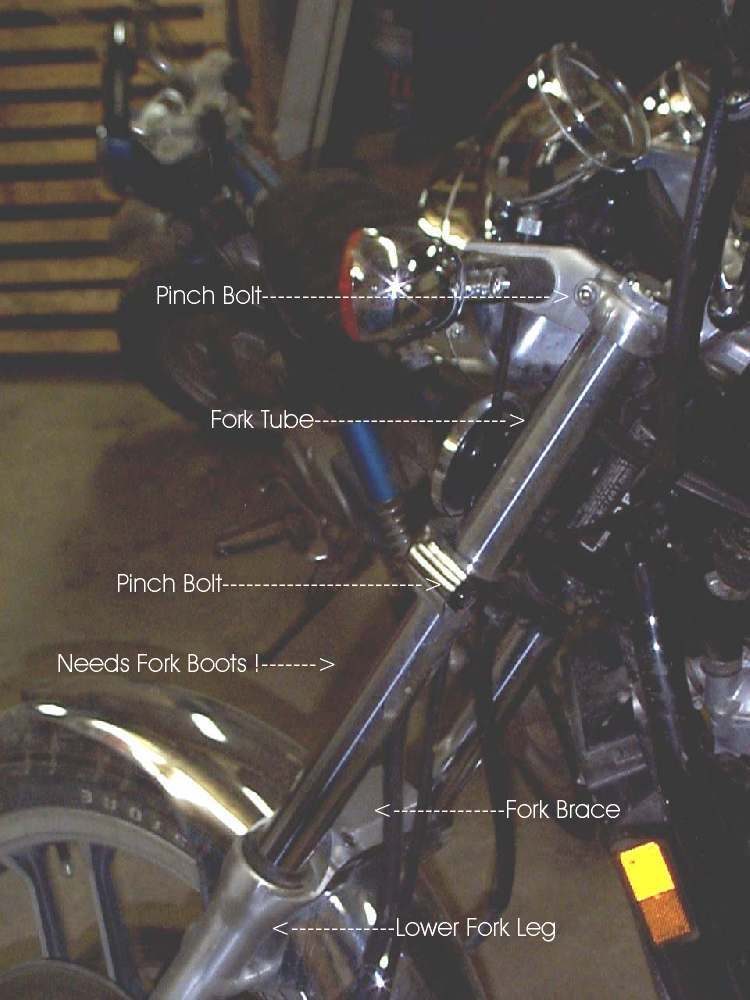
Most commuter bikes have telescopic forks: two legs, each with a shiny inner tube (stanchion) that slides inside an outer leg. A spring inside carries the weight and oil passing through small holes slows the movement (damping), so the bike does not keep bouncing. Oil seals at the top of each outer leg keep the oil in and dirt out. This quick inspection finds leaks, damage and loose parts.
Safety
- If oil from a fork has reached the brake disc or pads, do not ride. Clean the disc and replace oil-soaked pads.
- If a tube is visibly bent or the legs are uneven after a fall, do not ride.
You need
- A torch and a clean rag.
Steps
- Clean each stanchion with a rag, from the top of the seal upwards.
- Look at each stanchion in good light. Note rust spots, pits, scratches or chips, especially in the area that slides through the seal. A pitted tube tears new seals.
- Look at the dust seals (the rubber caps on top of the outer legs) and below them. A wet ring of oil on the tube, oil running down the leg, or dirt stuck in oil means a leaking seal.
- Hold the front brake on and push the bars down hard several times (K-Light 125 manual check). The forks should move smoothly and return without knocking, sticking or a hiss of trapped air.
- Wipe the tubes again and look for a fresh oil ring left by the seal.
- With the brake still on, rock the bike forward and back. A clunk from the fork legs or bottom of the forks suggests worn fork bushes, a loose axle or a loose caliper.
- Check the bolts you can see are tight: caliper bolts, axle nut, pinch bolts, mudguard bolts. A loose mudguard or cover rubbing can sound like a fork noise.
- Stand in front and compare the two legs: same height above the top yoke, and the wheel straight with the bars.
Check your work
- You know if each leg is dry or leaking, smooth or sticking, quiet or noisy, and straight.
- Write it in your service record.
If it did not fix the problem
- Leak: Clean fork seals, then Oil leaking from a fork leg.
- Bottoms out or harsh: Front forks bottom out or Front forks feel harsh over bumps.
- Sticks, knocks or bent: Front forks feel sticky or stiff, Knocking or squeaking from the front forks, Fork legs are twisted or uneven.