
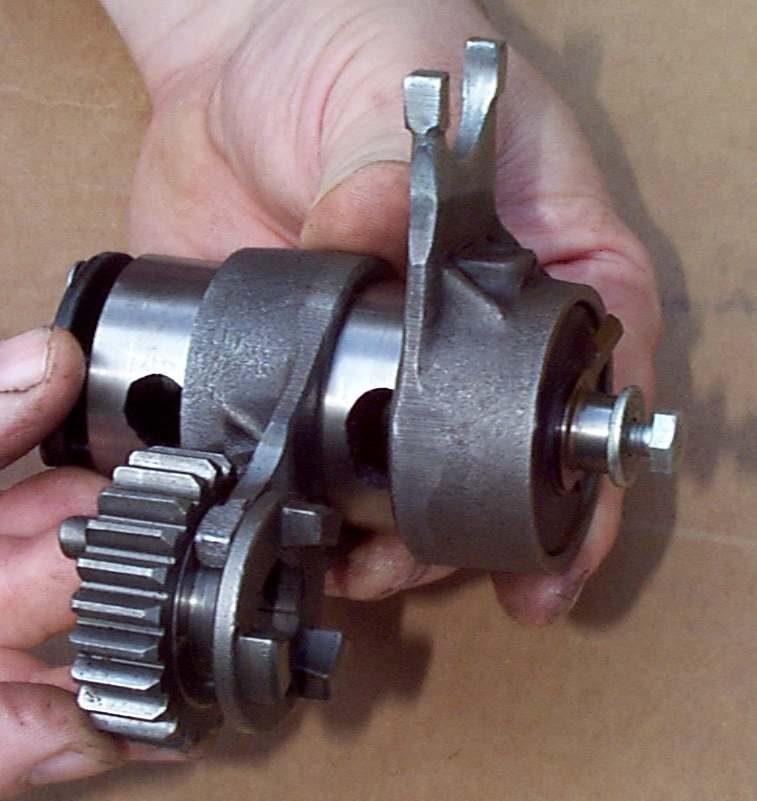
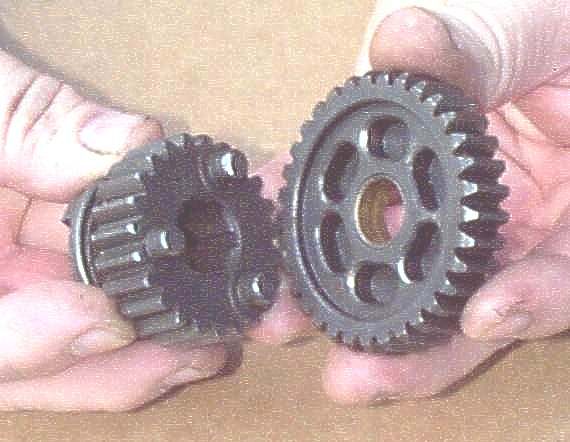
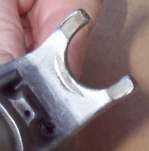
Commuter motorcycles use a constant-mesh gearbox inside the crankcase. All gears are always in mesh; a gear is selected when a fork slides a gear sideways so its dogs (square teeth on the side of the gear) lock into the next gear. The forks are moved by a drum, which the gear lever turns. A spring-loaded arm (the stopper or detent arm) holds the drum in each position. When dogs round off, forks wear or the stopper spring weakens, the bike jumps out of gear, finds false neutrals or gets stuck. This page is an assessment and hand-off: internal gearbox work needs the crankcase split and is not a home job.
Safety
- If the bike jumps out of gear or locks in gear, stop riding it hard. A sudden loss of drive, or a gear locking, can throw the rider off balance. Ride gently to the workshop or transport the bike.
- Do not force a stuck lever with your full weight or a bar. You can break the spindle or a fork.
Rule these out first
- Clutch adjustment and drag: Adjust clutch lever free play, Clutch drags.
- Lever and linkage: Check the gear lever and shift linkage.
- Oil level and condition, and metal in the drained oil: Check the engine oil level, Inspect drained oil for clues. Chunks of metal mean stop riding.
- Idle speed: too high makes gears clunk and resist. K-Light 125 idle: 1500 ± 100 rpm.
What the workshop will check
- Without splitting the engine: remove the clutch side cover and check the shift spindle, its return spring, the stopper arm and its spring, and the drum's star plate. On the K-Light these come off before the crankcase is split. A weak or broken spring here is the cheapest cause of jumping out of gear and lever not returning.
- Engine out and crankcase split: on the K-Light the engine is removed and the vertically split cases are separated to reach the drum, forks and shafts.
- Measure the fork shaft, fork bores, fork claw thickness, drum diameter and drum groove width against the limits (K-Light values below).
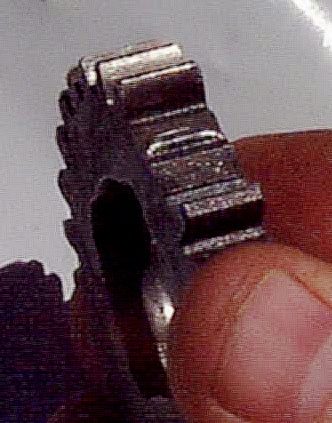
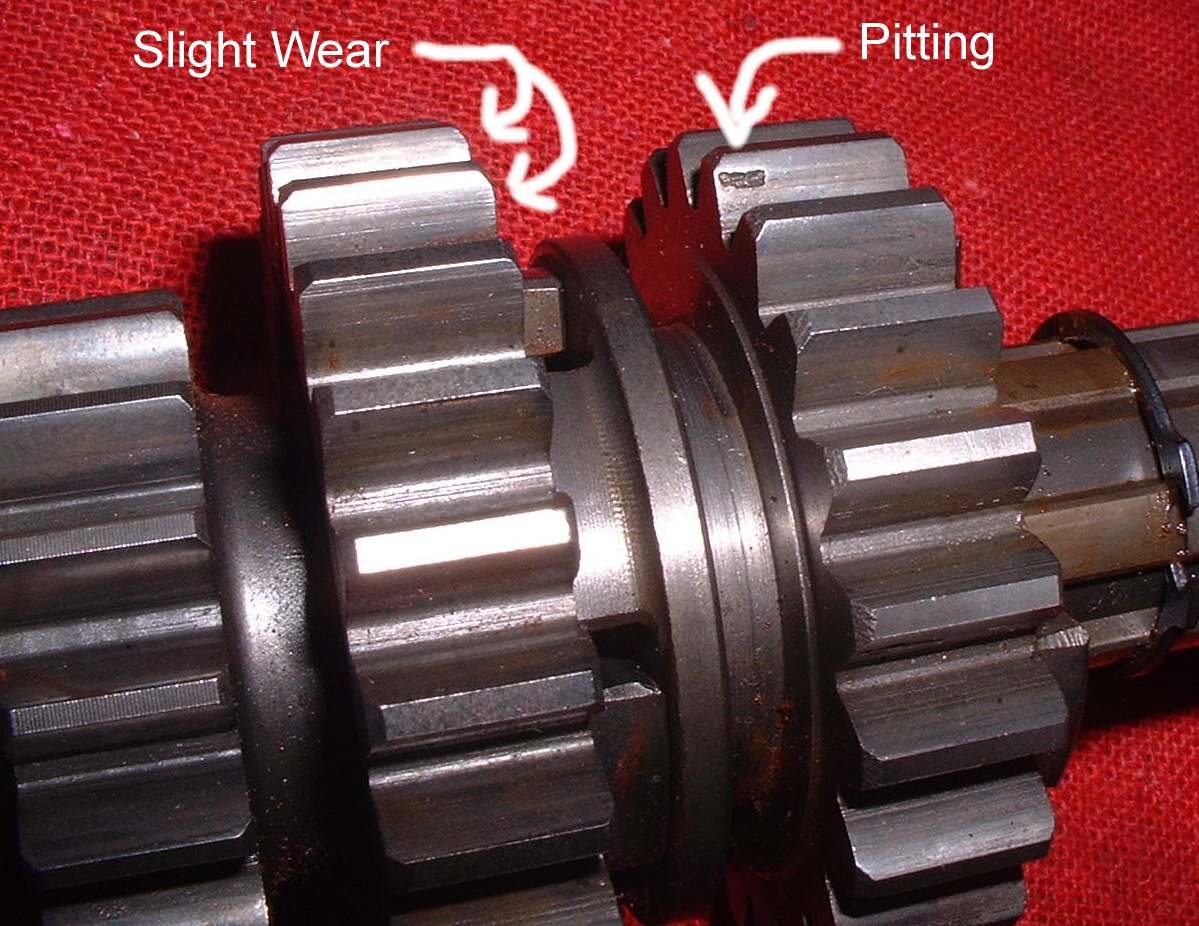
- Inspect the dogs and the slots they lock into. Rounded or tapered dogs and flared slots mean new gears. A worn fork usually caused the dog wear, so both are replaced.
- Check gear splines and the sliding gear grooves, gear teeth for chips or pitting, and all shaft bearings.
- Fit new bearings and seals wherever they were removed; the K-Light manual says removed bearings must not be reused. Oil every gear on assembly and check nothing binds.
What to ask for
- A written list of what was measured, the reading and the limit.
- The old parts, especially gears and forks, so you can see the wear.
- Whether the cause was found (for example a bent fork from forcing a stuck lever), not only the worn part.
Do not attempt at home
- Splitting the crankcase, removing shafts or pressing bearings without the model manual, pullers and seal tools.
If it did not fix the problem
- Gear changes still poor after an internal repair: recheck the clutch free play and lever position, which are often disturbed during engine work (Check the gear lever and shift linkage).
- A new whine or knock after reassembly: stop and return the bike to the workshop; see Whining noise in one or more gears.
Reference values (K-Light 125)
| Item | Standard | Limit | Source |
|---|---|---|---|
| Shift fork shaft outer diameter | 11.97 to 12 mm | 11.95 mm | K-Light 125 manual, PDF pp. 230, 232 |
| Shift fork bore | 12 to 12.018 mm | 12.05 mm | K-Light 125 manual, PDF pp. 230, 233 |
| Shift fork claw thickness | 4.93 to 5.0 mm | 4.7 mm | K-Light 125 manual, PDF pp. 230, 233 |
| Shift drum outer diameter | 35.8 to 36 mm | 35.75 mm | K-Light 125 manual, PDF pp. 230, 233 |
| Shift drum groove width | 7.05 to 7.15 mm | 7.3 mm | K-Light 125 manual, PDF pp. 230, 233 |
| Idle speed | 1500 ± 100 rpm | K-Light 125 manual, PDF p. 49 |