
Front axles are held in four common ways. Looking first shows which fasteners to loosen, in what order, and what has to go back in the same position. This check takes a few minutes and avoids forced parts or a wheel that will not drop out.
Safety
- Park on level ground with the bike supported so it cannot fall. Do not loosen anything on the axle until the front is lifted or the bike is on a stand.
- Engine off, key out. Let the brake disc and exhaust cool.
- Do not squeeze the brake lever while the wheel is out. The pads can close together or pop out.
You need
- The right spanners, sockets and hex keys for the axle, axle nut and pinch fasteners.
- The bike's manual, for the tightening values. If there is no manual, ask a dealer for the values. Do not guess them.
- A phone camera to record how everything sits before it comes apart.
Steps
- Look at both fork leg ends. Find the axle end. Note whether it has a nut on the far side, a bolt head on one side only, or a hex socket.
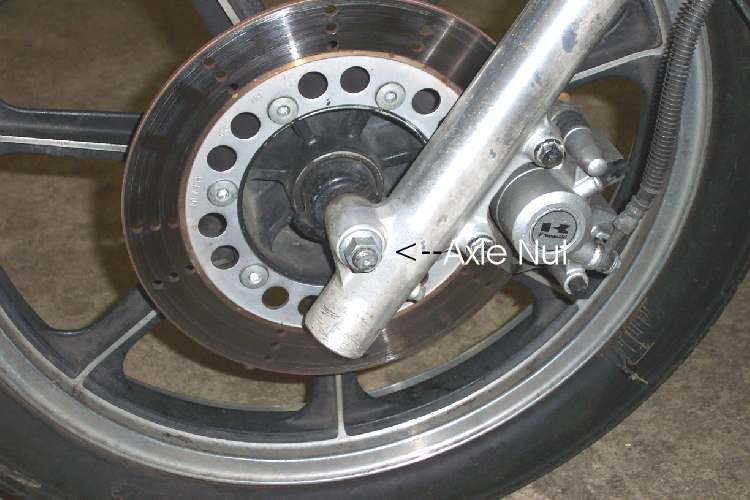
- Axle through the legs with a nut. The axle slides through both legs and the hub. A nut on one end holds it. Remove the nut, then pull the axle out.
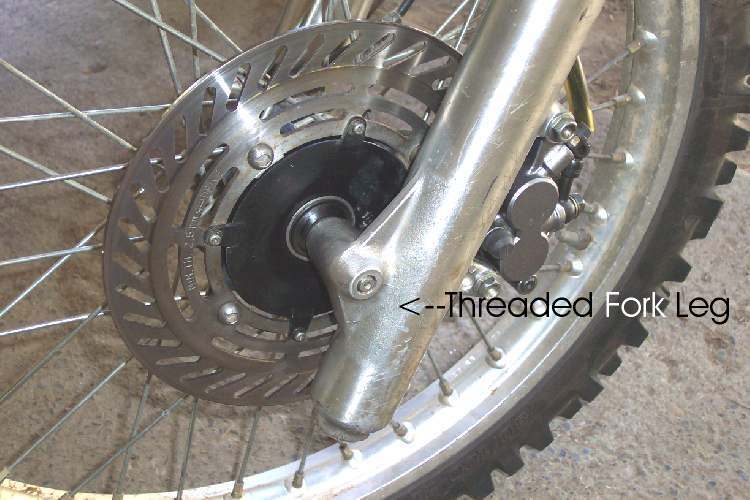
- Axle that screws into a fork leg. The axle threads into one fork leg. After any pinch bolt is loosened, unscrew the axle out of the leg.
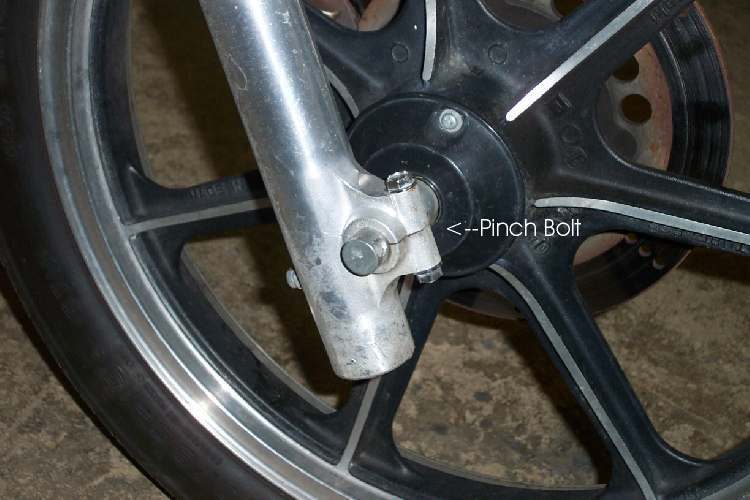
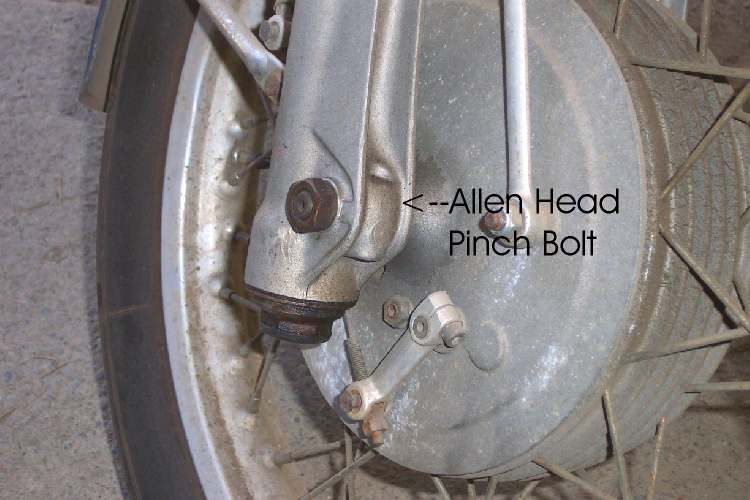
- Pinch bolt on the fork leg. A single bolt, with a nut or threaded into the leg, clamps the leg around the axle. Loosen it before the axle will turn or slide. An Allen (hex socket) pinch bolt is common.
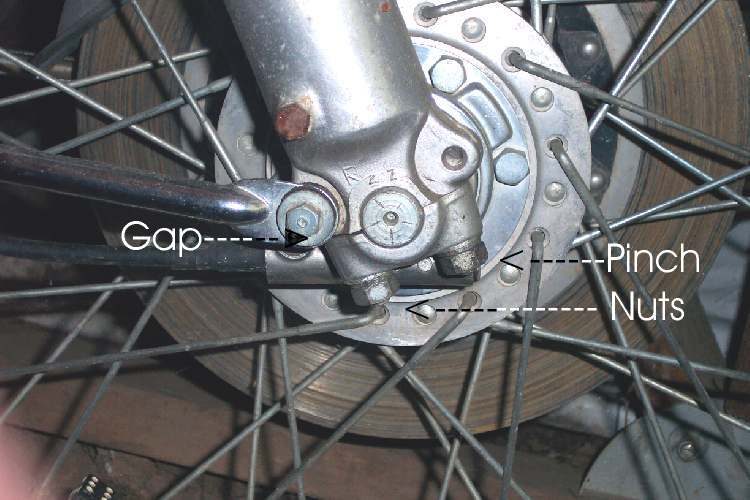
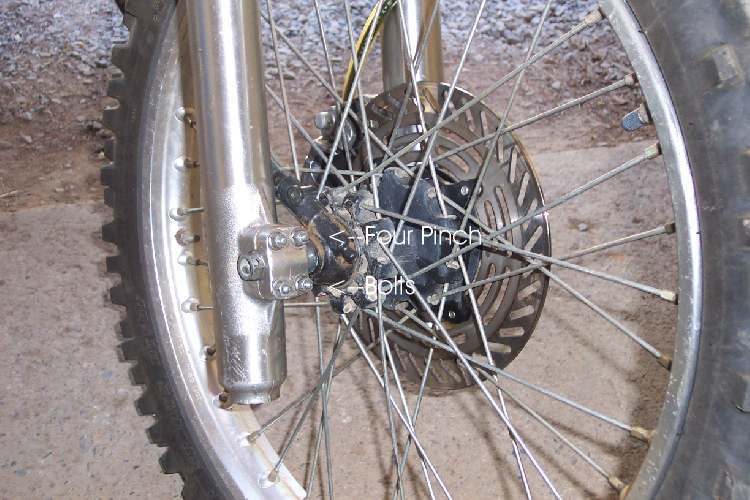
- Two or four pinch nuts. Some legs have two or four nuts on studs. Loosen all of them. Look for a gap in the clamp. On the two-nut type the gap usually faces the rear. On the four-nut type it usually faces down. A cast arrow on the clamp usually points up.
- Find the speedometer drive. On many disc brake bikes it sits on the outside of the hub, with a lug that stops it turning. On many drum brake bikes it sits inside the brake plate, with lugs that fit the hub. Photograph its position before the wheel comes out. It must go back the same way.
- Remove any plastic disc cover or guard. Handle it gently. Old plastic can be brittle.
- When refitting, tighten the axle nut or axle slowly by hand. A part that is going on wrongly will start to bind, and this is the time to stop. Then tighten to the value in the manual.
- On two-nut and four-nut clamps, tighten the fastener on the closed side fully first, then the one on the gap side. On the four-nut type, tighten the upper ones before the lower ones.
- On a drum brake wheel, leave the axle fasteners finger tight, spin the wheel, apply the brake and hold it on, then tighten everything. This centres the shoes in the drum.
Check your work
- The speedometer drive lug is seated and the drive turns freely.
- All pinch fasteners are tight to the manual value and the gap faces the way it did before.
- The wheel spins freely, the brake works, and the brake lever feels firm before riding.
If it did not fix the problem
- Full wheel removal and refitting: Remove and refit the front wheel.
- Front wheel not pointing straight after refitting: Align the front wheel with the handlebars.
- Speedometer reads nothing after the wheel is refitted: Speedometer does not work.
- Rumbling or play from the wheel: Check a wheel bearing.
- If an axle or pinch bolt is rusted or rounded, see Remove a stuck or rounded fastener or take the bike to a workshop.