
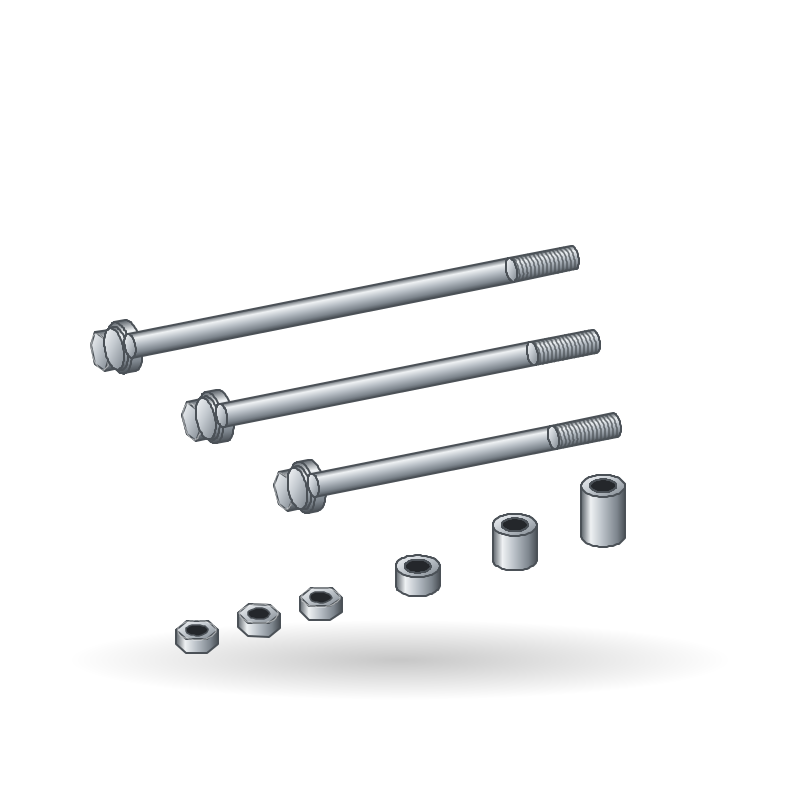
Engine mounting bolts are the long bolts that hold the engine to the frame, often through steel plates called hangers. A commuter single usually has a front, an upper and a rear mount. On many scooters and some bikes the engine swings on a pivot with rubber bushes. Electric bikes use similar bolts for the motor and battery cradle.
What it does
The mounts hold the engine in line with the frame and, on many bikes, the engine is part of the frame's strength. Loose bolts let the engine move, which shakes the bike, wears the bolt holes and can crack hangers. Rubber bushes stop vibration reaching the rider and wear out with age.
Signs it is worn or failing
- New or increased engine vibration.
- A clunk when opening or closing the throttle.
- Chain tight in some places or wearing fast if the engine has moved.
- Cracks around a hanger: Crack in the frame or a bracket.
When to replace it
Replace bolts that are bent, rusted thin or have damaged threads, and bushes that are cracked or soft. Use new self-locking nuts. Follow your bike's manual.
What to match when buying
- Match diameter, thread pitch, length and strength grade (the number on the bolt head, such as 8.8). Never fit a weaker or shorter bolt.
- Match the shoulder length on bolts that pass through bushes.
- Cheap bolts may be soft steel with no grade mark. Buy marked bolts from a known supplier.
Fitting notes
- Home job to check: Check engine mounting bolts. Removing all mounts is a workshop job; support the engine on a jack first.
- Fit all bolts loosely, then tighten in the order the manual gives, to the torque in the manual.
- Rock the rear wheel while watching the engine to check the bushes, as the K-Light manual suggests.
Reference (K-Light 125)
| Item | Value | PDF page |
|---|---|---|
| Front mount | 45 to 50 N·m | 191 |
| Upper mount | 22 to 29 N·m | 191 |
| Rear mount | 45 to 50 N·m | 191 |