
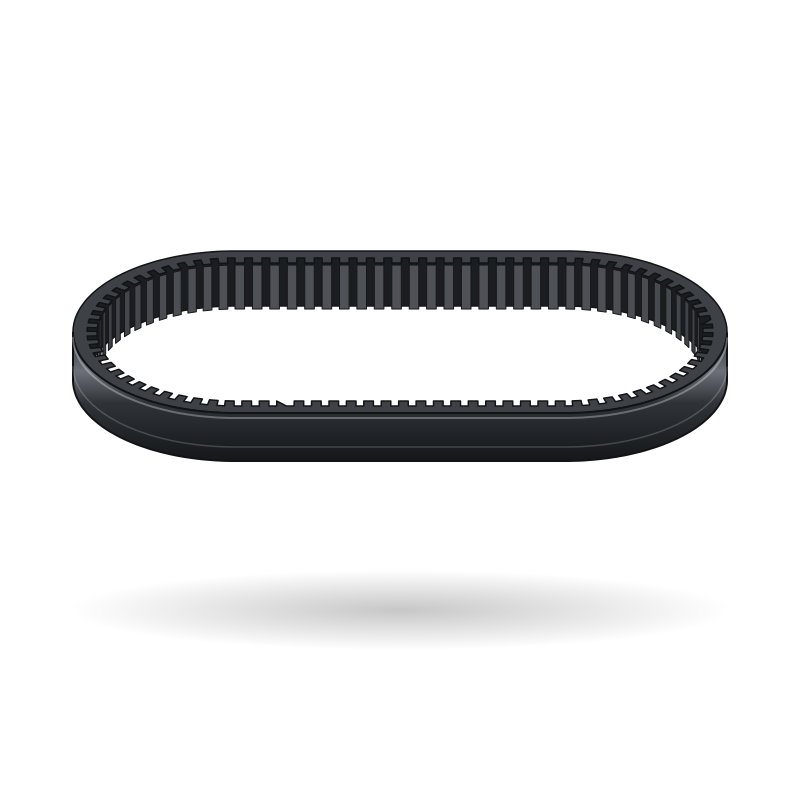
The drive belt is a toothed rubber V-belt inside the left side case of a scooter. It runs between the front pulley (the variator, on the engine) and the rear pulley (on the clutch). This is the CVT, or continuously variable transmission.
What it does
Each pulley is two cone-shaped halves. When the front halves close together, the belt rides high on a large radius; at the back the halves open and the belt sits low. This changes the gear ratio smoothly as speed rises. The belt carries all the power by gripping the pulley faces, so it wears thinner, cracks and gets hard with heat. A narrow belt sits lower in the pulleys, so top speed falls.
Signs it is worn or failing
- Revs rise but speed builds slowly: Scooter revs but accelerates slowly.
- Lower top speed: Scooter will not reach top speed.
- Squeal, slap or judder: Noise from the drive case, Scooter judders.
- Belt broken, engine revs with no drive: Drive belt has broken. Push the scooter; do not ride.
When to replace it
Replace at the interval in your scooter's manual, or sooner if the belt has cracks, missing teeth, frayed edges, oil on it, or is narrower than the minimum width in the manual.
What to match when buying
- The belt code printed on the old belt: it gives length and width. Match it exactly.
- Make, model, year and engine size. Belts for 110, 125 and 150 cc versions of one scooter often differ.
- Buy a belt in a sealed sleeve with the maker's name and part number. Very cheap belts may be the wrong rubber and break early.
Fitting notes
- Clean belt dust out of the case and wipe the pulley faces dry. Oil on the faces makes a new belt slip.
- Check the rollers and clutch at the same time.
- Home job with the correct holding tool: Inspect and replace the scooter drive belt.