
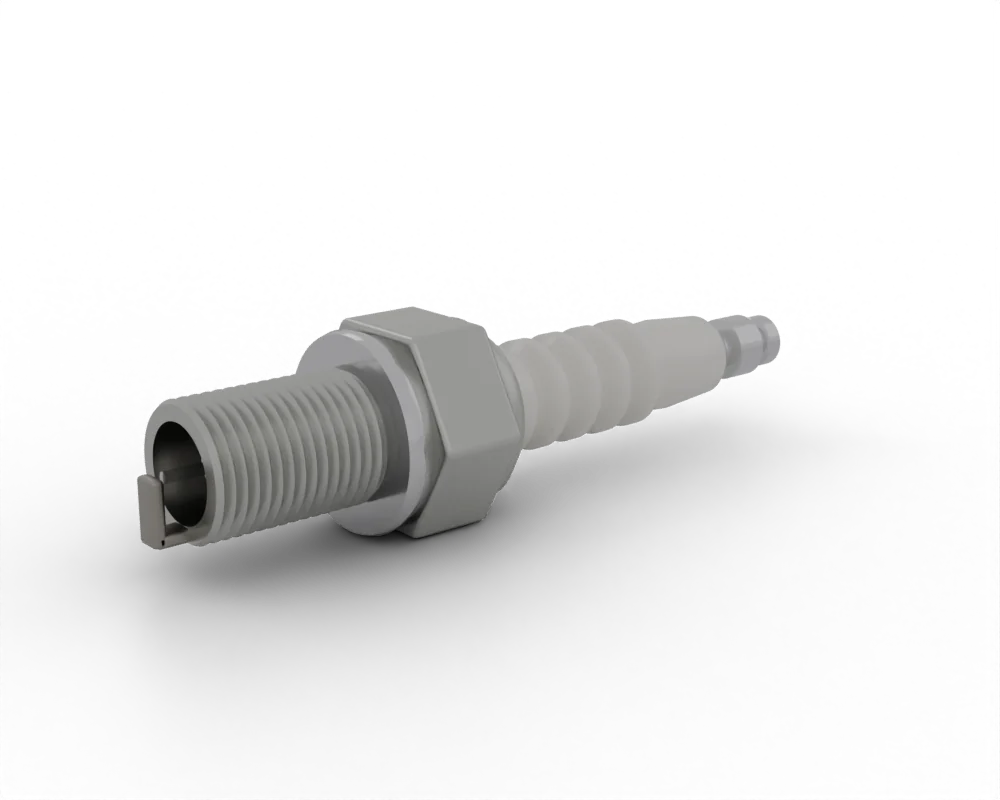
What a spark plug is made of
A spark plug has a steel shell with a thread and a sealing seat, an aluminium-oxide ceramic insulator, a centre electrode (nickel alloy, often with a copper core, or fine platinum or iridium wire), and an earth electrode welded to the shell. The gap between the two electrodes is where the spark jumps. Resistor plugs also contain a resistor of about 5 kΩ that limits radio interference.
Heat range: why plugs run at a set temperature
The insulator nose must run between about 450 °C, below which carbon and oil deposits build up and the plug fouls, and about 850 °C, above which the tip glows and can ignite the mixture before the spark. The heat range describes how quickly the insulator passes heat to the shell and the cylinder head. A hot plug has a long insulator nose and suits low-load commuting; a cold plug has a short nose and suits sustained high load.
Plug codes encode heat range, and the direction varies by brand. In the NGK system, and the brands that follow it, a higher number means a colder plug; Bosch and Champion number heat ranges the other way. The K-Light 125, the commuter used as the worked example in the Moto Zero course, uses a D7RTC: D for the M12 × 1.25 thread family, 7 for the heat rating, R for a built-in resistor and C for a copper-cored centre electrode. Always confirm an equivalent from a published cross-reference rather than by matching digits.
When to read a plug
Read the plug after a run at steady load, not after idling, which leaves soot on any plug. For a precise reading of the full-throttle mixture, mechanics use a plug chop: the engine is stopped while running under load at the throttle opening being tested, so that it never idles before the plug comes out. Clean round the plug before removing it so that dirt cannot fall into the cylinder.
What the colours mean
| Appearance | Meaning | Next step |
|---|---|---|
| Light grey or tan insulator, little deposit | Normal combustion, correct heat range | None |
| Dry black soot | Rich mixture, blocked air filter, choke or enricher left on, too much idling, plug too cold, weak spark | Check the filter, enricher, mixture and ignition |
| Wet black oily deposit | Oil entering past rings or valve guides; on a two-stroke, too much oil or flooding | Compression and leak-down test |
| Chalk-white blistered insulator, eroded electrodes | Overheating: lean mixture, air leak, ignition too far advanced, plug too hot | Find the cause before riding further |
| Small metal specks on the insulator | Detonation or piston damage beginning | Stop and inspect |
| Glazed yellow-brown deposits | High-speed running after deposits built up, fuel additives | Replace the plug |
| Wet with fuel after cranking | Flooding or no spark | Spark test |
A white plug is the one to act on quickly, because the lean mixture or over-advanced timing that causes it can hole a piston. A dry sooty plug on a city bike that fouls regularly needs the mixture checked first; if the mixture is right, a hotter plug (one number lower in the NGK system) may help.
Setting the gap
The spark needs more voltage to jump a wider gap, and the requirement rises as the electrodes wear round. The K-Light 125 gap is 0.7 ± 0.1 mm. Measure it with a wire-type gauge, not a flat feeler gauge, which reads wrongly on worn, rounded electrodes. Adjust by bending only the earth electrode, and never lever against the centre electrode or the insulator.
Fit the plug by hand first so that it cannot cross-thread, then tighten it to the specified torque: 15 N·m on the K-Light. A plug with too long a reach can strike the piston or valves; one with too short a reach leaves carbon in the exposed head threads.
Replace a plug whose electrodes are eroded or corroded, whose insulator is cracked, or which is carbon-fouled.
Caps, resistors and misfires
The spark is a fast current pulse that radiates interference and can upset ECUs and instruments, so a resistor plug, a suppressor cap (typically 5 kΩ) or a resistive lead limits it. Fitting a non-resistor plug and a non-resistor cap to an ECU-controlled engine can cause erratic running. A cap that has cracked or absorbed water lets the spark track to earth, causing a misfire in wet weather.
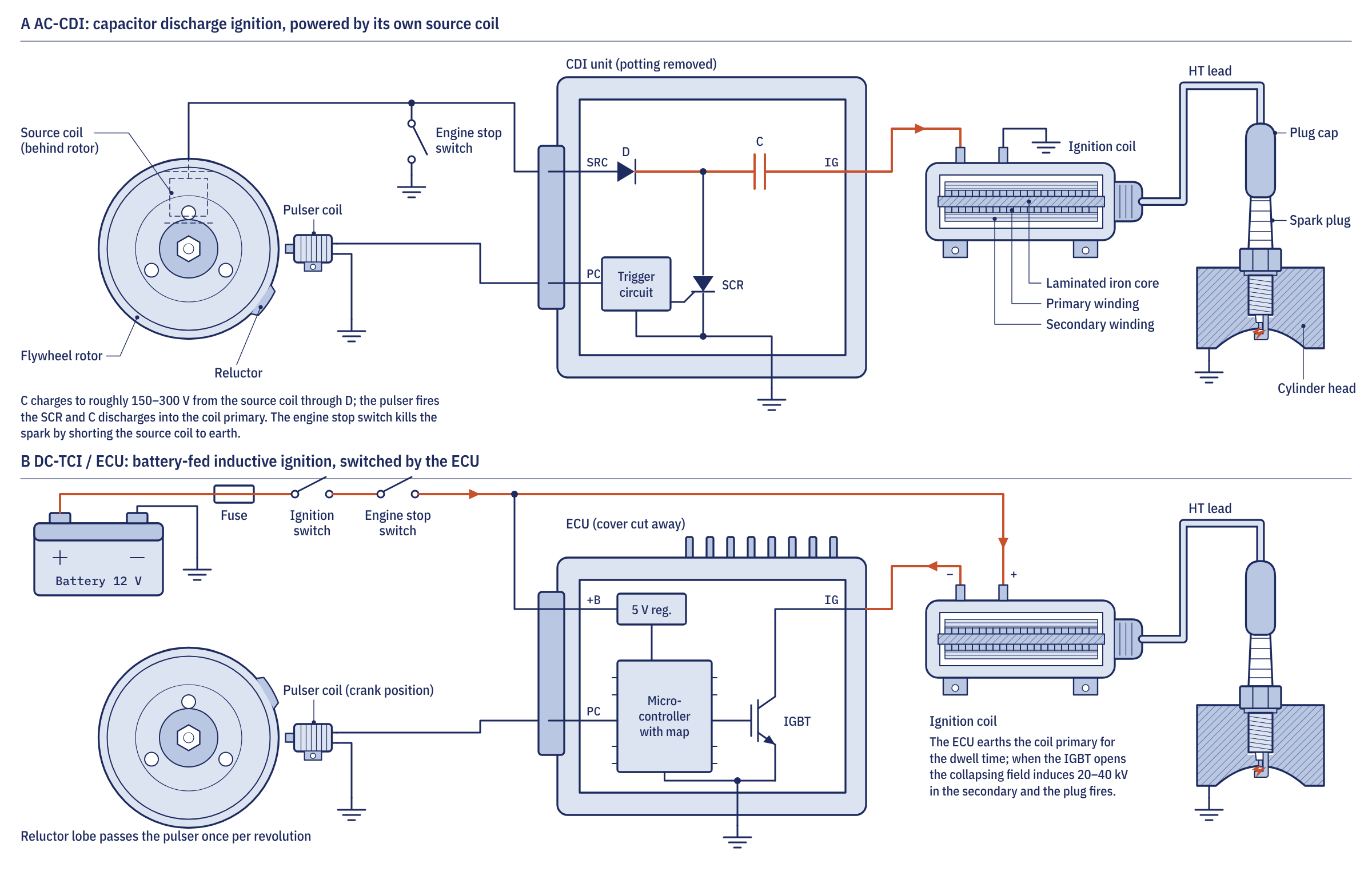
Two-strokes usually use capacitor discharge ignition (CDI), whose voltage rises so fast that the spark fires before it can leak away across an oily insulator. That suits engines whose plugs foul with oil, but the spark is short, so a two-stroke's plug colour also depends heavily on its oil ratio.
Testing for a spark
If the engine will not start, fit the plug into an insulated spark tester set to about 6 to 8 mm, earth it and crank. A strong blue-violet spark is good; a weak orange spark or none points to the plug, the cap, the coil or the trigger. Our guide to diagnosing a motorcycle that will not start continues from there.
Ignition systems produce up to 35 kV. Never hold a plug or lead with bare hands during a spark test, and use an insulated tester rather than holding a plug against the cylinder head.
The spark plug page in the Repair section collects the related faults. Chapter 3.3 of the course, Ignition systems, explains coils, CDI and ignition timing, and our carburettor cleaning guide covers the mixture faults that plugs reveal.
Frequently asked questions
What colour should a motorcycle spark plug be?
A light grey or tan insulator with little deposit means normal combustion and the correct heat range. Black soot means rich, wet oil means oil entry, and chalk white means overheating.
What should the spark plug gap be on a 125 cc motorcycle?
Use the figure for your model. The K-Light 125 specifies 0.7 ± 0.1 mm with a D7RTC plug. Measure with a wire-type gauge.
Is a higher spark plug number hotter or colder?
In the NGK system a higher number is colder. Bosch and Champion number the other way, so always use a published cross-reference.
Why is my spark plug black?
A dry black sooty plug usually means a rich mixture: a blocked air filter, the choke left on, a fault in the fuel system, a lot of idling, or too cold a plug. A wet black oily plug means oil is getting in.
Written by Transitions Lab for the Moto Zero open motorcycle course. Text and illustrations are licensed CC BY-SA 4.0. Figures and values come from the course modules; see sources and credits.