
The short answer
An engine needs compression, a correctly timed spark and the right mixture, and the MAVCC Motorcycle Mechanic course teaches diagnosis from the least invasive check to the most invasive. Before dismantling anything, confirm the simple things: there is fuel in the tank, the battery is charged, the air filter is not blocked and the engine has oil. Then split the problem in two by asking one question: does the engine turn over when you press the starter?
Step 1: does the engine turn over?
If the starter does not turn the engine, the fault is in the battery or the starting circuit, not in the fuel or ignition. If the engine turns over at a normal speed but does not fire, the battery and starter are fine and the search moves to spark, fuel and compression.
Step 2: the starter does not turn the engine
Check the battery first
Measure the battery voltage with a multimeter after the machine has stood for at least an hour. The K-Light 125 manual, the commuter used as the worked example in the Moto Zero course, gives 13.1 V for a fully charged battery and 12.3 V as the point where it needs charging. While cranking, a healthy battery should not drop below about 9.6 V. If the horn is weak and the starter does nothing, a flat battery or a loose terminal is the usual cause. Our guide to a battery that keeps going flat covers the full battery and charging tests.
Then the interlocks
The starter relay will only operate when the safety switches allow it. The neutral switch permits starting in neutral, the clutch switch permits starting in gear with the lever pulled, and the engine stop switch usually cuts the relay supply as well. On many scooters and on the K-Light 125, the brake lever must also be pulled. Check every switch before reaching for tools.
Listen for the relay
The start button carries only a small current to the relay coil; the relay then switches the heavy current to the starter motor. If there is no click, the fault is on the control side: a switch, the start button, the fuse or the relay coil. If the relay clicks but the starter does not turn, the relay contacts are burned or the starter itself has failed. A voltage-drop test while cranking separates them. On the positive side, from the battery post to the starter terminal, the drop should be 0.5 V or less; across the relay contacts, 0.2 V or less; and on the earth side, 0.3 V or less.
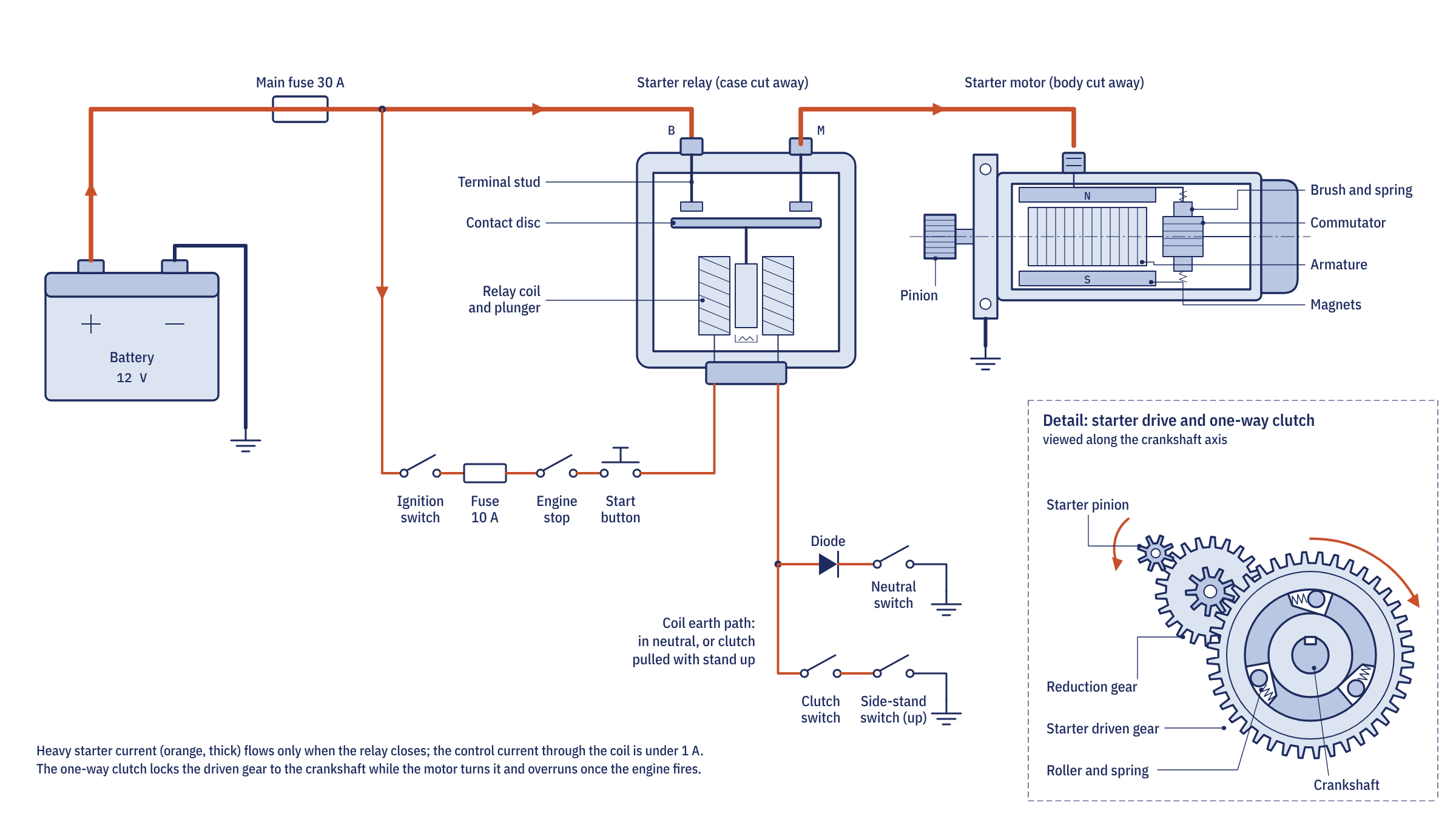
If the starter spins freely with a whirring noise but the engine does not turn, the one-way starter clutch is slipping. The Motorcycle Mechanic course names this as the commonest starter fault.
Step 3: it cranks but will not fire
The K-Light 125 fault trees follow a fixed order, and it works for most four-strokes.
Check for spark
Remove the plug and look at it. Fit it, or a new plug, into an insulated spark tester set to a gap of about 6 to 8 mm, earth the tester and crank. A strong blue-violet spark is good; a weak orange spark or none means the ignition system needs testing: the plug cap, the coil, the crankshaft sensor and the switches. Our article on reading a spark plug explains what the plug's colour says about the engine.
Ignition systems produce up to 35 kV. Never hold a plug or lead with bare hands during a spark test, and do not crank an engine with electronic ignition while the plug lead is disconnected and not earthed, because the unrestrained voltage can damage the coil or the control unit.
Good spark: is fuel arriving?
After cranking, look at the plug again. A dry plug means no fuel is reaching the cylinder. On an injected bike, listen for the fuel pump running for about 3 seconds when the key is turned on; the K-Light system holds a fuel pressure of about 300 kPa. On any bike, check the tank vent: a blocked vent lets the engine run for a few kilometres, then starve, and it restarts after the filler cap is opened with a hiss. On a carburetted bike, check that the fuel tap is on (or on reserve if the tank is low), that a vacuum tap is not stuck, and that the bowl fills. A wet plug means the engine is flooded, from repeated cranking, a leaking injector or a carburettor float stuck open.
Spark and fuel: check compression
With spark and fuel confirmed, measure compression with the engine warm, the throttle fully open and a fully charged battery. A healthy K-Light 125 reads 1.0 to 1.2 MPa. Low compression comes from valve clearances that have closed up, leaking valve seats, worn or stuck rings, or an intake leak. Valve clearance is the cheaper fix, so check it before planning a top-end repair.
It starts, then stops
If the engine fires and then dies, the K-Light tree points first to a blocked air filter and a blocked by-pass passage in the throttle body. On a carburetted bike, a partly blocked pilot jet gives the same symptom; our carburettor cleaning guide explains how to tell.
Quick reference
| What happens | Likely cause | First check |
|---|---|---|
| Nothing, horn weak | Flat battery, loose terminal | Battery voltage and terminals |
| Nothing, no relay click | Interlock switch, start button, fuse, relay coil | Stop switch, brake or clutch lever, neutral, fuse |
| Relay clicks, starter silent | Burned relay contacts, worn starter brushes | Voltage drop across the relay while cranking |
| Starter spins, engine still | Starter clutch slipping | Inspect the starter clutch |
| Cranks, no spark | Plug, cap, coil, crankshaft sensor, switches | Spark test, then each part in turn |
| Cranks, spark, plug dry | No fuel: vent, tap, pump, filter | Tank vent, pump or tap, fuel at the bowl |
| Cranks, spark, plug wet | Flooding, leaking injector, float stuck | Dry the plug and retry |
| Spark and fuel, still no start | Low compression | Compression test, valve clearance |
Electric motorcycles
An electric motorcycle has no spark, fuel or compression, but the same logic applies: confirm the battery's state of charge, then the interlocks (side stand, kill switch and often a brake lever), then look for a fault message from the battery management system or controller. Never open a traction battery or controller; packs above 60 V DC need trained technicians. Our guide to how electric motorcycles work describes the parts involved.
For symptom-by-symptom help, the Repair section's problem finder lists common faults with their causes, and the parts pages for the battery, spark plug, carburettor and wiring collect the related checks. Chapter 3.6 of the course, Electrical diagnosis, gives the full ignition and starter job sheets.
Frequently asked questions
Why does my motorcycle click but not start?
A single click from the relay with no starter movement usually means a flat battery, a loose terminal, burned relay contacts or a worn starter. Check battery voltage first, then measure the voltage drop across the relay and cables while cranking.
Why will my motorcycle turn over but not start?
The engine is missing spark, fuel or compression. Do a spark test with an insulated tester, look at whether the plug is dry or wet after cranking, and then do a compression test if both spark and fuel are present.
Can a blocked fuel tank vent stop a motorcycle?
Yes. Fuel drawn from a sealed tank creates a vacuum that eventually stops the flow. The engine runs for a while, then stops, and restarts after the filler cap is opened.
Why does my motorcycle only start with the brake lever pulled?
Many scooters and some motorcycles, including the K-Light 125, have a brake lever switch in the starter relay circuit as a safety interlock, so the starter only works with the brake applied.
Written by Transitions Lab for the Moto Zero open motorcycle course. Text and illustrations are licensed CC BY-SA 4.0. Figures and values come from the course modules; see sources and credits.