Moto Zero stands on a shelf of earlier work: a vocational curriculum, a factory service manual, a technician starter kit and a museum catalogue. Here is what each one is, what it contributed, and where to find it.
AThe course
Moto Zero modules
Five free PDF modules by Transitions Lab, released under CC BY-SA 4.0. The Learn and Quiz pages on this site are built from them.
Baugus, M. & Fulkerson, D. (Ed.). Mid-America Vocational Curriculum Consortium, Stillwater, Oklahoma. ERIC document ED 319 915.
A 19-unit, competency-based course in entry-level motorcycle mechanics: safety, tools, metric measurement, fasteners, engines, battery and electrical service, carburation, wheels and tyres, steering and suspension, brakes, clutches, starting, tune-ups, pre-delivery and one-cylinder top-end service. The backbone for the workshop and job-sheet approach of Moto Zero.
View on ERIC →Service manual · KS Motorcycles / Qianjiang · 278 pages
Maintenance Manual: K-Light 125
KS Motorcycles. Maintenance Manual of Two-wheeled Motorcycle (K-LIGHT125).
The factory manual for a current fuel-injected 125 cc single: specifications, fault diagnosis, inspection intervals and procedures for the battery and charging, ignition, starter, lighting, brakes and CBS, wheels and suspension, chain drive, fuel system, lubrication and cylinder head. Every reference value and service limit in Moto Zero maps onto this machine.
Hero Honda technician starter kit, Unit 2: The Motorcycle (IGNOU course material).
A compact general description of the motorcycle and its systems (four-stroke petrol engine, lubrication, constant-mesh gearbox, clutch, chassis and electrics), written for trainee technicians working on 100 cc commuter machines.
Exhibition catalogue · Guggenheim Museum · 1998
The Art of the Motorcycle
Solomon R. Guggenheim Museum, New York, 1998.
The catalogue of the landmark exhibition: a century of motorcycle design from the steam velocipede to the superbike, with essays on technology, culture and form. The source for the history and design-lineage sections of Module 01.
Each Moto Zero module closes with its own list of textbooks, regulations and standards (Euro 5+, BS VI, IEC charging standards and more). See the final pages of each PDF.
CRepair course
Dan’s Motorcycle Repair Course
Text and photographs from Dan’s Motorcycle Repair Course (dansmc.com) are used with the owner’s permission. They feed the Repair pages (repairs, problems and parts), their photographs and the course chapters, across 274 repair pages, 287 problem pages, 172 part pages and 500 bike pages from 30 makes. The lesson pages used are listed below, grouped by course section; each link opens the original page on dansmc.com.
Documents and references that Dan’s lessons point to
Dan’s lessons link to outside documents that the lesson files did not include. Only real references are listed here, by topic. Outside links open the publisher’s own site and may change over time.
Safety
US helmet standard, 49 CFR 571.218: the federal safety standard behind the DOT helmet mark (2011 edition, PDF), linked from the Helmets lesson.
These PDFs were linked from Dan’s lessons. They are scans of manufacturer manual pages and charts. Their rights stay with the original publishers and they are not covered by the Moto Zero licence.
Battery state of charge table: open circuit voltage, state of charge, specific gravity and freeze point (1 page). From the Batteries lesson.
Four third-party documents sit in the project’s reference folder. They are used as sources only and are not republished. Where a public original exists it is linked.
Document
What it is
How it was used
Public original
MAVCC Motorcycle Mechanic, ED319915
Teacher edition of a competency based vocational course (877 pages).
Model identity in Repair, By bike comes from the VehiclesDB motorcycle catalogue. It is used with the credit it asks for: vehicle data by VehiclesDB, licensed CC BY 4.0. No endorsement by VehiclesDB is implied.
Manufacturer pages
Official manufacturer pages were checked for model names and specifications. They are cited on each bike page. The main ones:
Plates, renders and 3D models: by Transitions Lab, CC BY-SA 4.0 (38 course plates, 289 3D models and their renders).
HLicence & credits
Use and credits
Moto Zero is an open educational programme of Transitions Lab. Text, illustrations, 3D models and renders are released under Creative Commons Attribution-ShareAlike 4.0. You may copy, translate, adapt and redistribute them with attribution, under the same licence.
The 3D models (289 GLB files), their renders and the 38 course plates were made by Transitions Lab for the course and are released under CC BY-SA 4.0; the Blender scripts that generate every model are in the repository under source/3d. Photographs from the Transitions Lab collection (module covers and in-chapter photographs) are excluded from that licence.
The source documents and linked references on this page belong to their respective authors and publishers and are cited here for reference; they are not covered by the Moto Zero licence.
Workshop procedures are general guidance. Specifications differ between machines, so always confirm values and torque settings in the manufacturer’s service manual for the motorcycle in front of you. Numbers in the interactive Lab are illustrative.
IThe asset package
What the course is built from
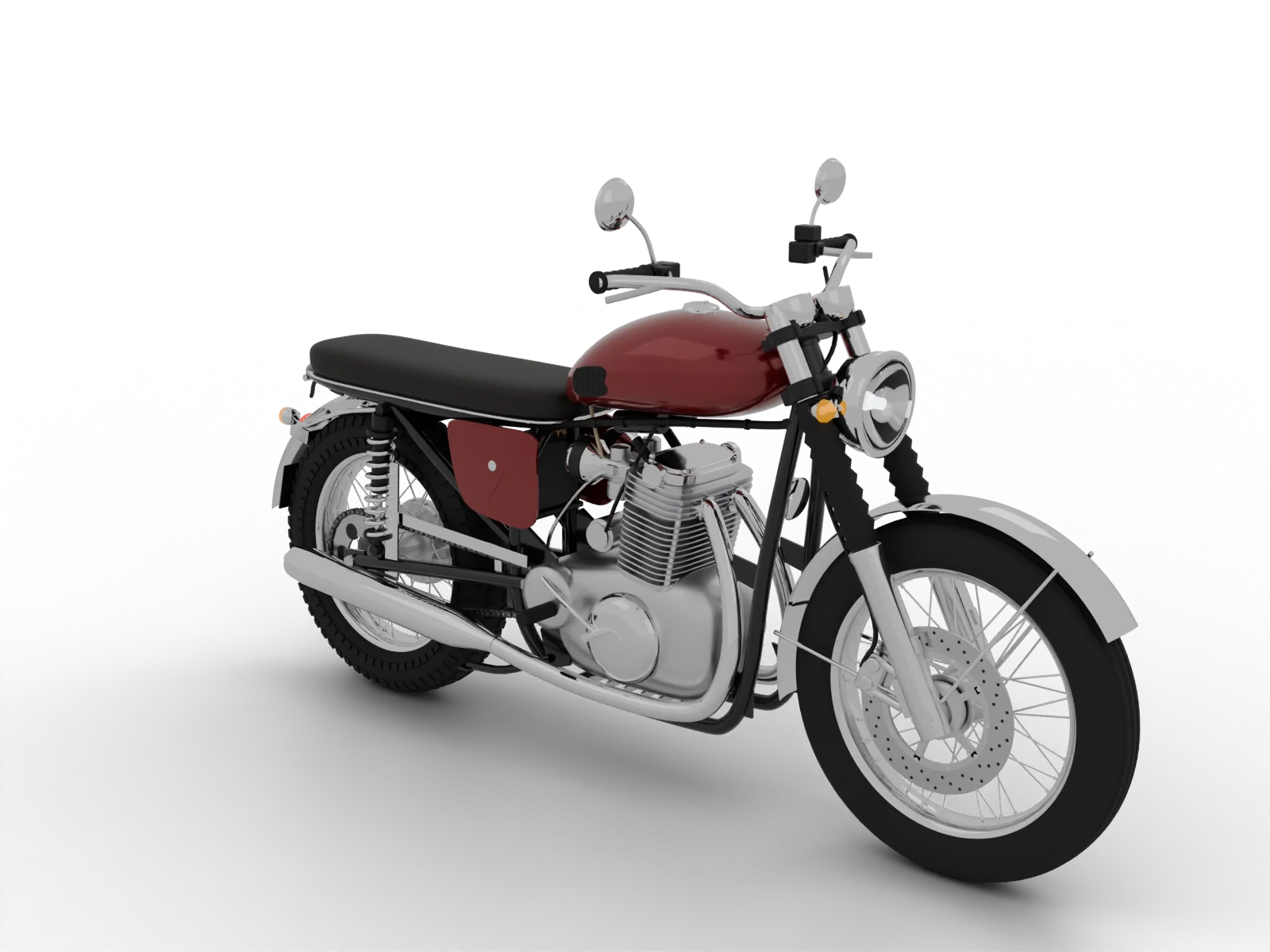
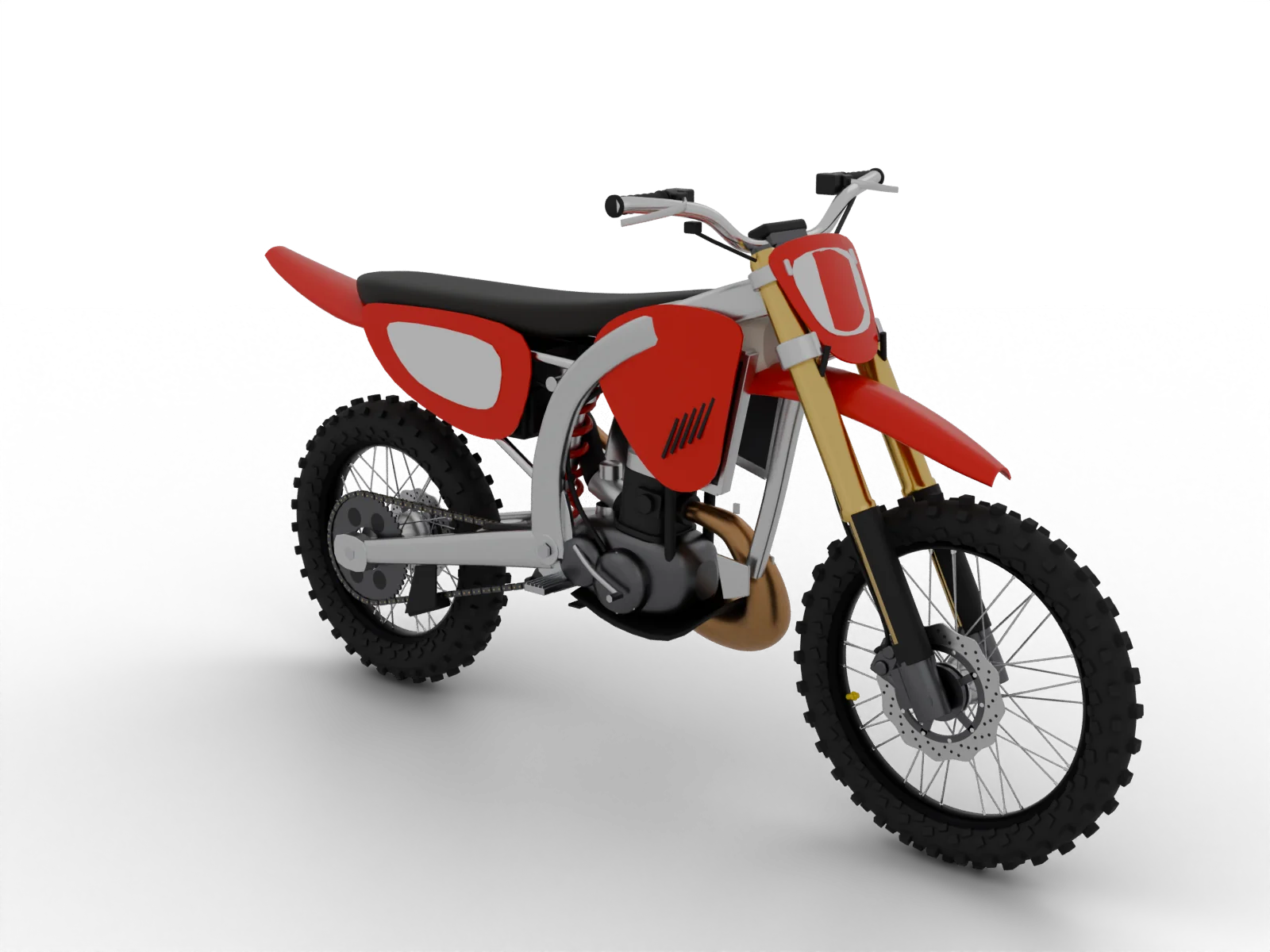
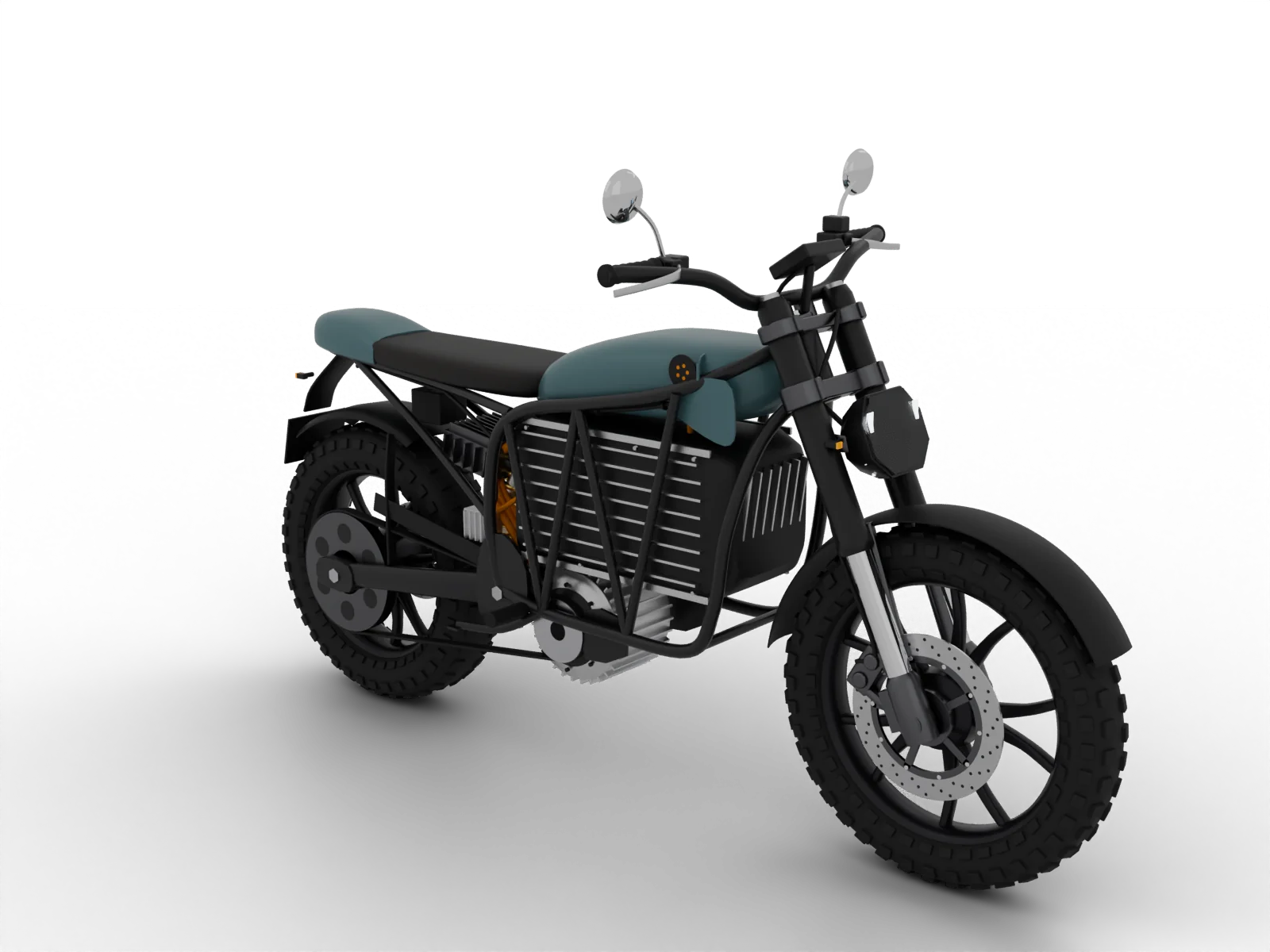
Five PDF modules, 38 course plates, 289 3D models with more than 300 rendered stills, the Transitions Lab photographs, the controls cockpit and the Moto Zero identity. Everything below is part of the same CC BY-SA 4.0 package, apart from the photographs noted above.
Electric · scrambler with mid-mounted motor and belt drive. Open in the Overview
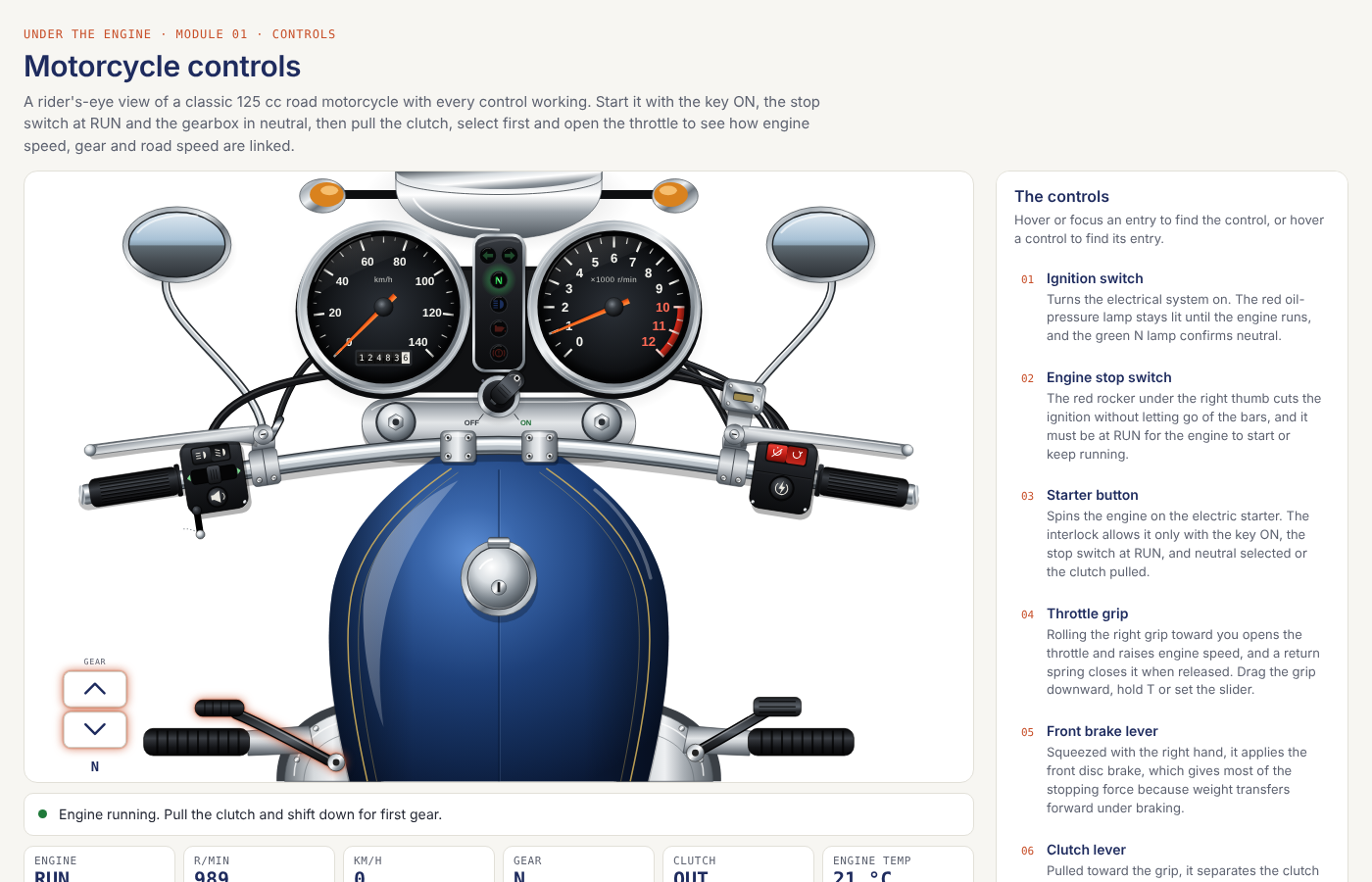
The controls cockpit
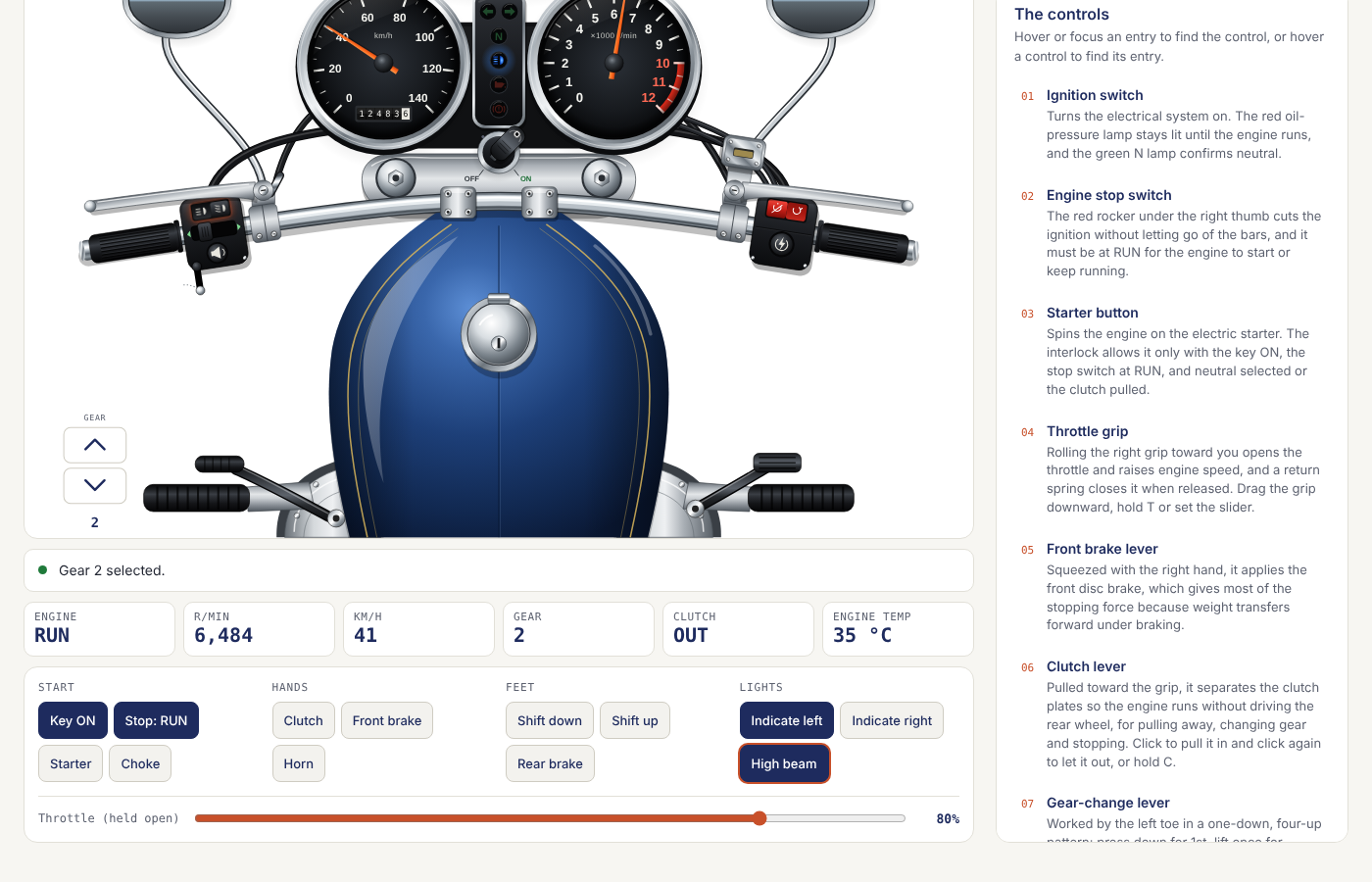
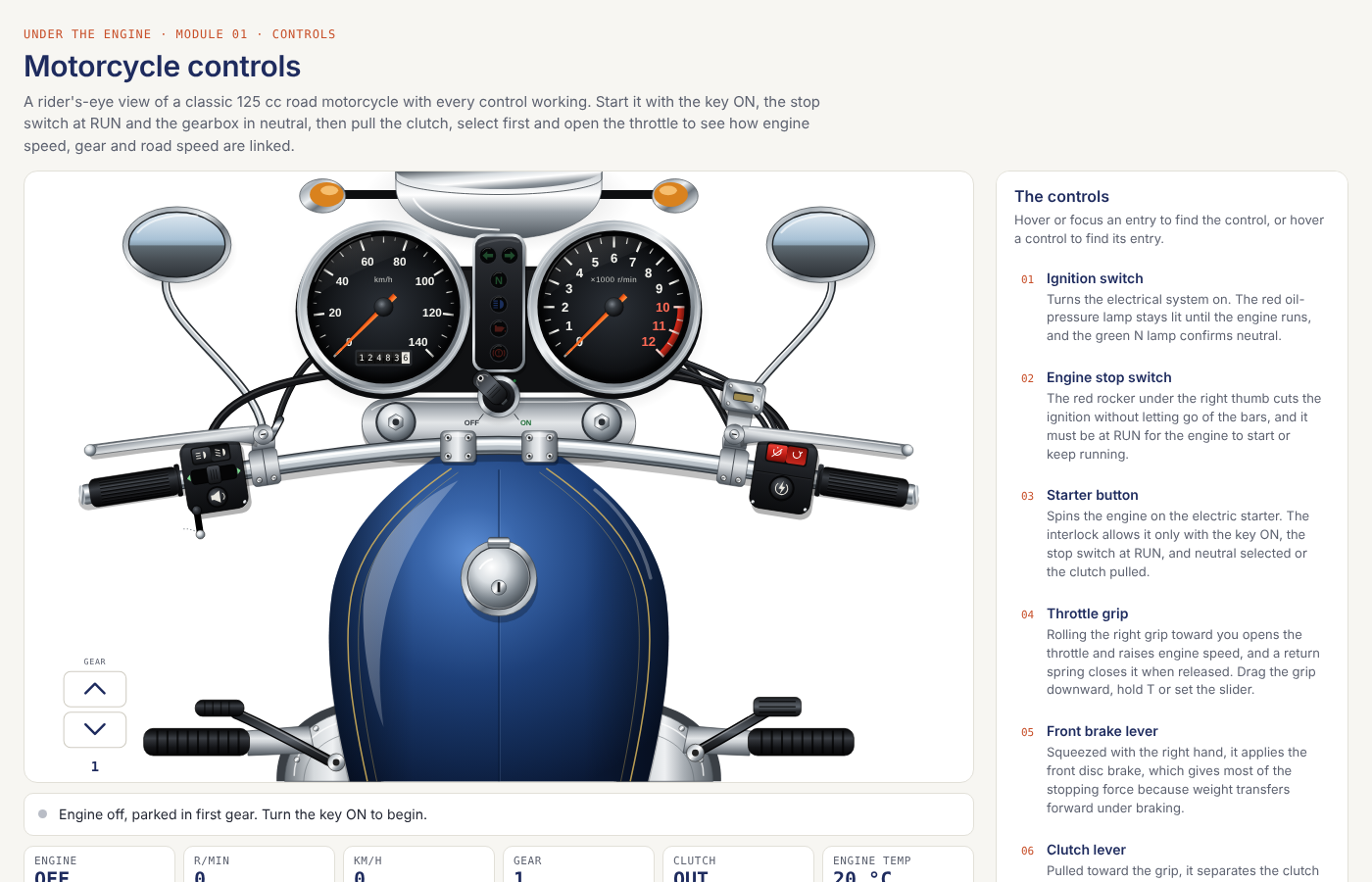
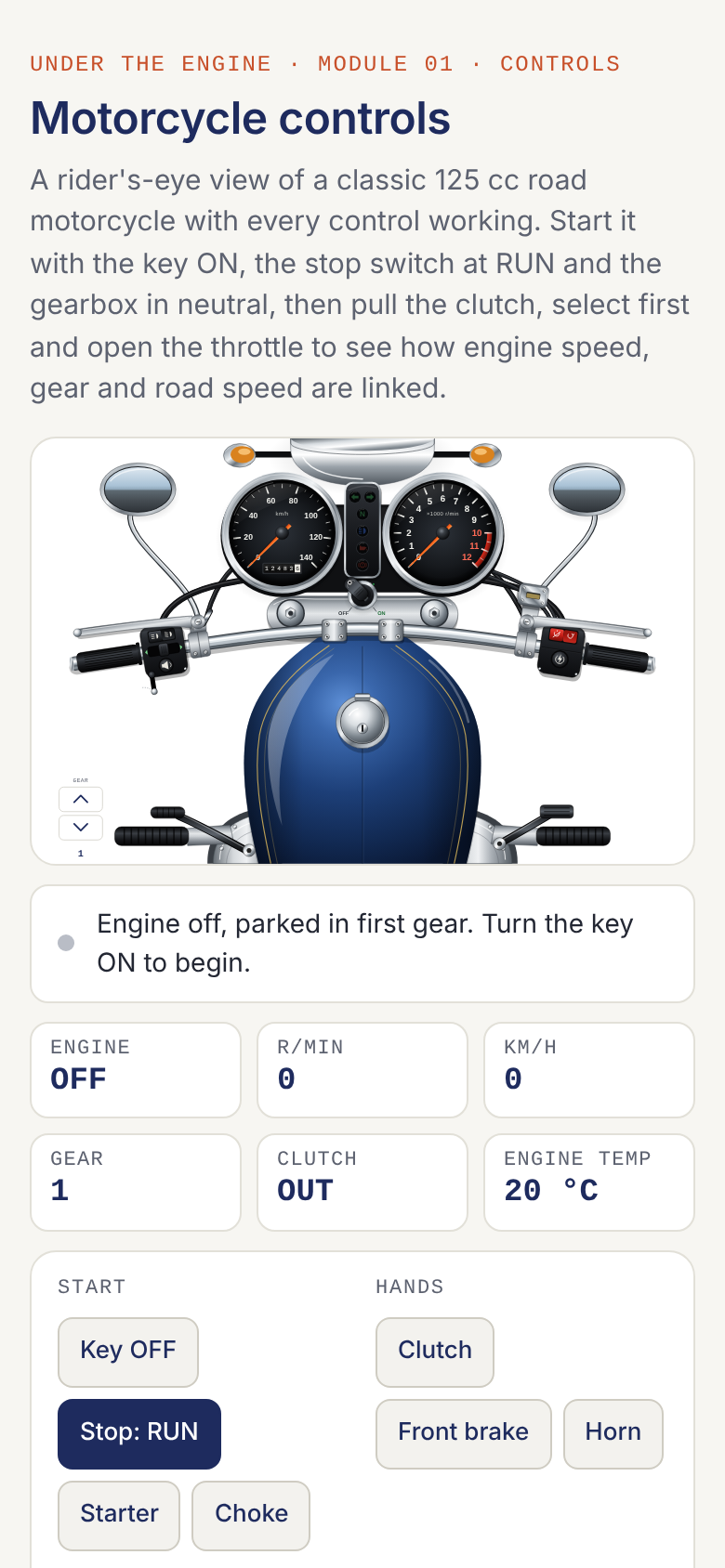
The interactive cockpit puts every primary control of a road motorcycle under the learner’s hands: throttle, both brakes, clutch, gear lever and the switch clusters, with live instruments.
Lockup · for light backgroundsReverse lockup · for dark backgrounds
Mark · favicon and small sizes
JDownload and collaborate
Download the 3D models
The motorcycle and component models used on this site can be downloaded from the Moto Zero collection on Sketchfab, for teaching, study and your own projects under the same CC BY-SA 4.0 licence.
If you need a model, part or drawing that is not on the site or on Sketchfab yet, write to marcel@transitionslab.org. Transitions Lab is open to collaborations: new models, translations, teaching adaptations and partnerships that help spread technical education on motorcycles, combustion and electric.