
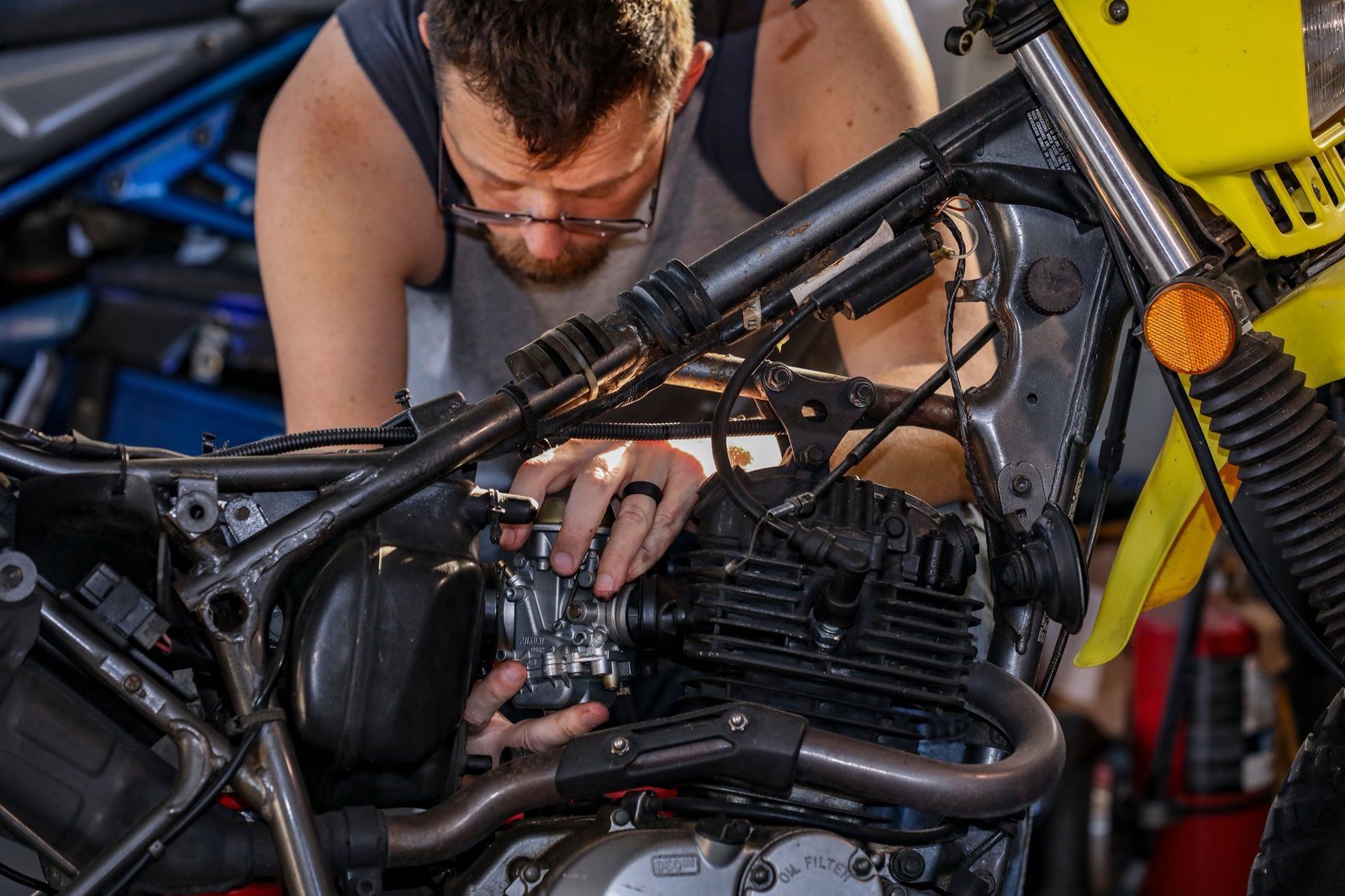
How a carburettor meters fuel
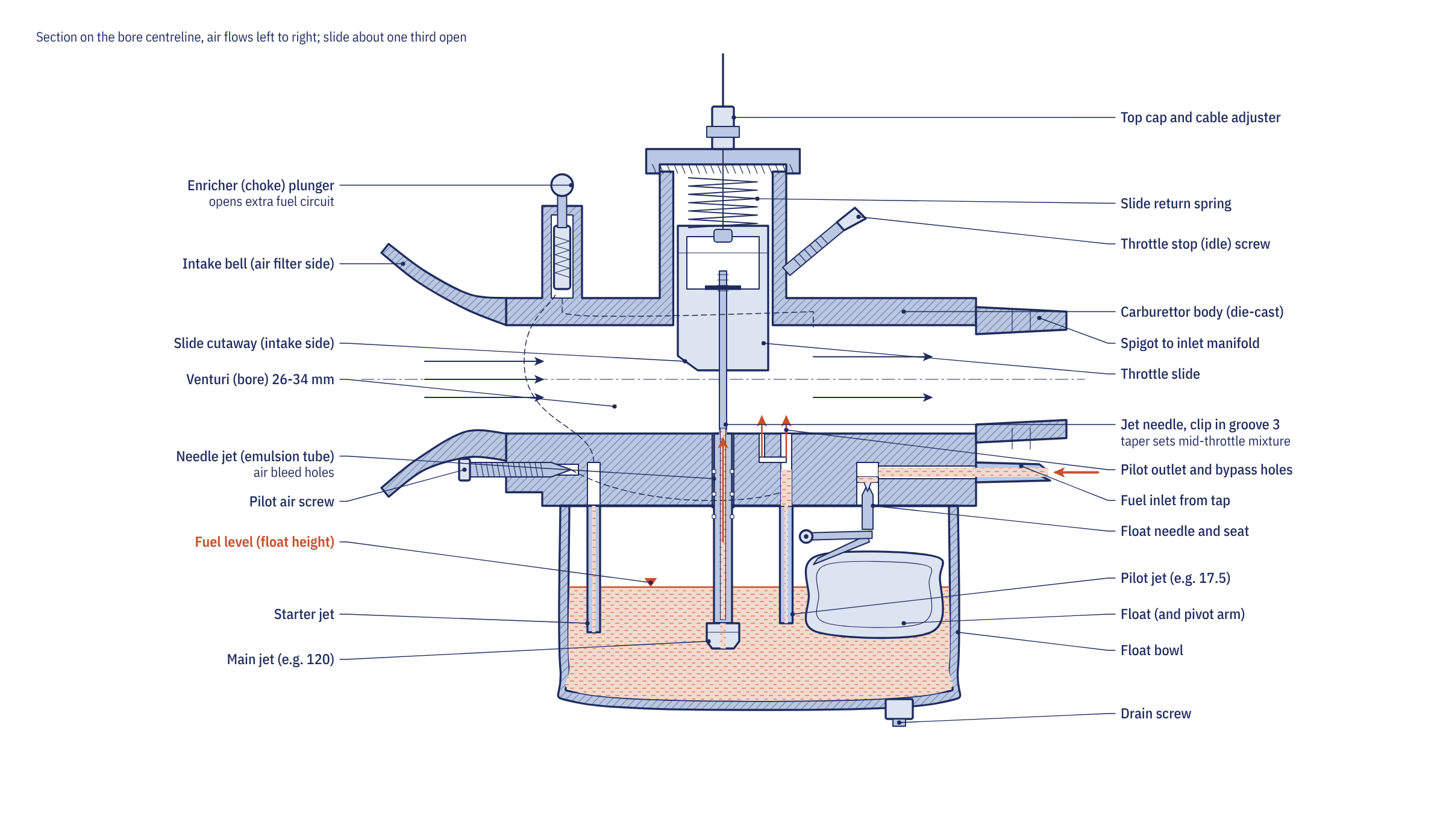
As the piston descends on the intake stroke, air rushes through the carburettor. Where the passage narrows, at the venturi or under the throttle slide, the air speeds up and its pressure falls. A fuel nozzle opens into this low-pressure zone, while the float bowl above the fuel is vented to the atmosphere, so fuel is pushed up through calibrated jets into the airstream. The float and its needle valve keep the fuel in the bowl at a constant height, so that the jets always draw from the same level.
Because a single jet cannot hold the mixture right from idle to full throttle, a carburettor has several overlapping circuits. Each one dominates a portion of the throttle opening, not of engine speed, and that is the key to diagnosis.
Match the symptom to the circuit
| Throttle opening | Circuit in charge | Typical symptom when blocked or wrong |
|---|---|---|
| Closed to 1/8 | Pilot jet and pilot (mixture) screw | Poor idle, stalling, hard starting, stumble just off idle |
| 1/8 to 1/4 | Slide cutaway and by-pass holes | Hesitation as the throttle starts to open |
| 1/4 to 3/4 | Jet needle and needle jet | Surging or running hot at part throttle |
| 3/4 to full | Main jet | Power falls away or engine cuts at full throttle |
| Cold start | Enricher (starter) circuit | Will not start cold, starts fine warm |
The pilot jet has the smallest passages and is usually the first to block, and a partly blocked pilot jet is the classic cause of a bike that will not idle without the choke. The enricher on most modern carburettors works best with the throttle shut, and opening the throttle during a cold start weakens it.
Check these before blaming the carburettor
- Air filter. A blocked filter increases the depression on every jet and makes the mixture rich at all openings. It is the first check for an over-rich mixture in the K-Light 125 fault trees, the manual used as the worked example in the Moto Zero course.
- Air leaks. A split intake rubber, a loose clamp or a cracked heat insulator lets in unmetered air and leans the mixture, mostly at idle.
- Tank vent. A blocked vent lets the engine run for a few kilometres, then stop; it restarts after the filler cap is opened with a hiss.
- Fuel tap. Check the filter gauze on the tap's standpipe, the ON and reserve positions, and on a vacuum-operated tap the diaphragm and its vacuum hose.
- CV diaphragm. On a constant-velocity carburettor, a torn diaphragm leaves the piston down, so the engine idles and runs but will not rev beyond a moderate speed. Lift the piston by hand and check that it falls smoothly, and hold the diaphragm up to a light to look for pinholes.
- Spark plug. A dry black sooty plug points to a rich mixture; a white blistered plug points to a lean one. Our guide to reading a spark plug shows how.
Also check the float level. A float set too high enriches every circuit, and if the needle sticks open the bowl overflows through its overflow tube. A float set too low leans every circuit and causes surging at high speed.
When to clean
Clean the carburettor when the symptom matches a circuit and the simpler causes above have been ruled out, when fuel has been left to stand in the bowl and the bike now runs only on the choke, or when you find dirt or water in the float bowl. Cleaning is not a cure for wrong jetting: a change of altitude, exhaust or air filter alters the airflow, and the course's jetting chapter explains how to correct the mixture in the right order, main jet first.
How to clean and inspect
The MAVCC Motorcycle Mechanic course, one of the sources for the Moto Zero modules, sets out a workshop procedure for a full clean in a dip tank. The main points apply to any method.
- Drain and remove. Drain the float bowl into a container, never onto a hot engine, and work in a ventilated area away from sparks and flames.
- Strip it. Note the pilot screw position by counting the turns to lightly seated before removing it. Remove the float, needle, jets, slide or piston and the enricher.
- Keep rubber out of the cleaner. Remove all O-rings, the diaphragm and gaskets. Carburettor cleaner destroys rubber parts.
- Soak, rinse and dry. Lower the metal parts in a basket into the cleaner for the time on the cleaner's directions (the MAVCC job sheet gives fifteen to thirty minutes), drain, rinse thoroughly in cold water, then blow out every passage and dry the parts with compressed air.
- Check the jets against the light. Look through each jet. Clear a blockage with compressed air or aerosol cleaner, never with a wire or drill bit, which enlarges the calibrated hole. Replace any jet that will not clear.
- Inspect the wear parts. A worn float needle shows a ring round its tapered seating face; replace the needle and seat together. Check the float pin for wear, and shake the float near your ear: fuel inside means it is leaking. Check the slide for deep scratches, the slide guide pin for damage, and the jet needle for straightness and wear at the clip.
- Reassemble with new O-rings and gaskets, set the float height to the manual figure, and return the pilot screw to its counted position.
Carburettor cleaner is a toxic chemical. Wear a face shield and rubber gloves, take care when lifting the basket and rinsing, and beware of residue blowing back when drying with compressed air. Wash any splash off skin with plenty of water and soap. Do not wash carburettor parts in a parts-washer solvent tank, which contaminates the solvent.
Screws, jets and numbers
On a carburettor whose adjusting screw sits on the engine side of the slide, it is a fuel screw and turning it out richens the idle mixture; on the intake side it is an air screw and turning it out leans it. Many constant-velocity carburettors built since the 1980s have the fuel screw sealed for emissions reasons. Main jet numbers are not the same between brands: on Mikuni hex mains the number is proportional to flow, while on Keihin mains it approximates the hole diameter in hundredths of a millimetre.
Fuel-injected bikes
Most new motorcycles, including the K-Light 125, use fuel injection instead. The throttle body still collects carbon round the butterfly, but it is cleaned differently: spray carburettor cleaner into the bore with the butterfly opened by the cable, never by forcing a tool into the bore, and keep the cleaner off the throttle position sensor. Many ECUs then need an idle relearn.
The carburettor page and the air filter page in the Repair section collect the related faults and checks. Chapter 3.1 of the course, Air, fuel and mixture, covers every circuit, the jetting method and carburettor synchronising.
Frequently asked questions
How do I know if my motorcycle carburettor needs cleaning?
Typical signs are an engine that will only idle on the choke, stalls or stumbles just off idle, or loses power at a particular throttle opening, after the air filter, tank vent, fuel tap and air leaks have been checked.
Can I clean carburettor jets with a wire?
No. A wire or drill bit enlarges the calibrated hole and changes the mixture. Use compressed air or aerosol cleaner, and replace a jet that will not clear.
Why does my motorcycle only run with the choke on?
The engine is running lean at small throttle openings. The usual causes are a partly blocked pilot jet or an air leak between the carburettor and the engine.
Should rubber parts go in carburettor cleaner?
No. Remove all O-rings, gaskets and the diaphragm first, because carburettor cleaner destroys rubber.
Written by Transitions Lab for the Moto Zero open motorcycle course. Text and illustrations are licensed CC BY-SA 4.0. Figures and values come from the course modules; see sources and credits.