
Why a commercial motorcycle needs more care
Service schedules are written for average riders. The K-Light 125 manual, used as the worked example in the Moto Zero course, bases its schedule on about 1,000 km a month and asks for shorter intervals on dusty roads and at high mileage. A boda boda rider covering 120 km a day reaches 1,000 km in little more than a week, often two-up or loaded, on roads that are dusty in the dry season and muddy in the wet. Every interval in the manual therefore arrives several times sooner than it would for a private rider.
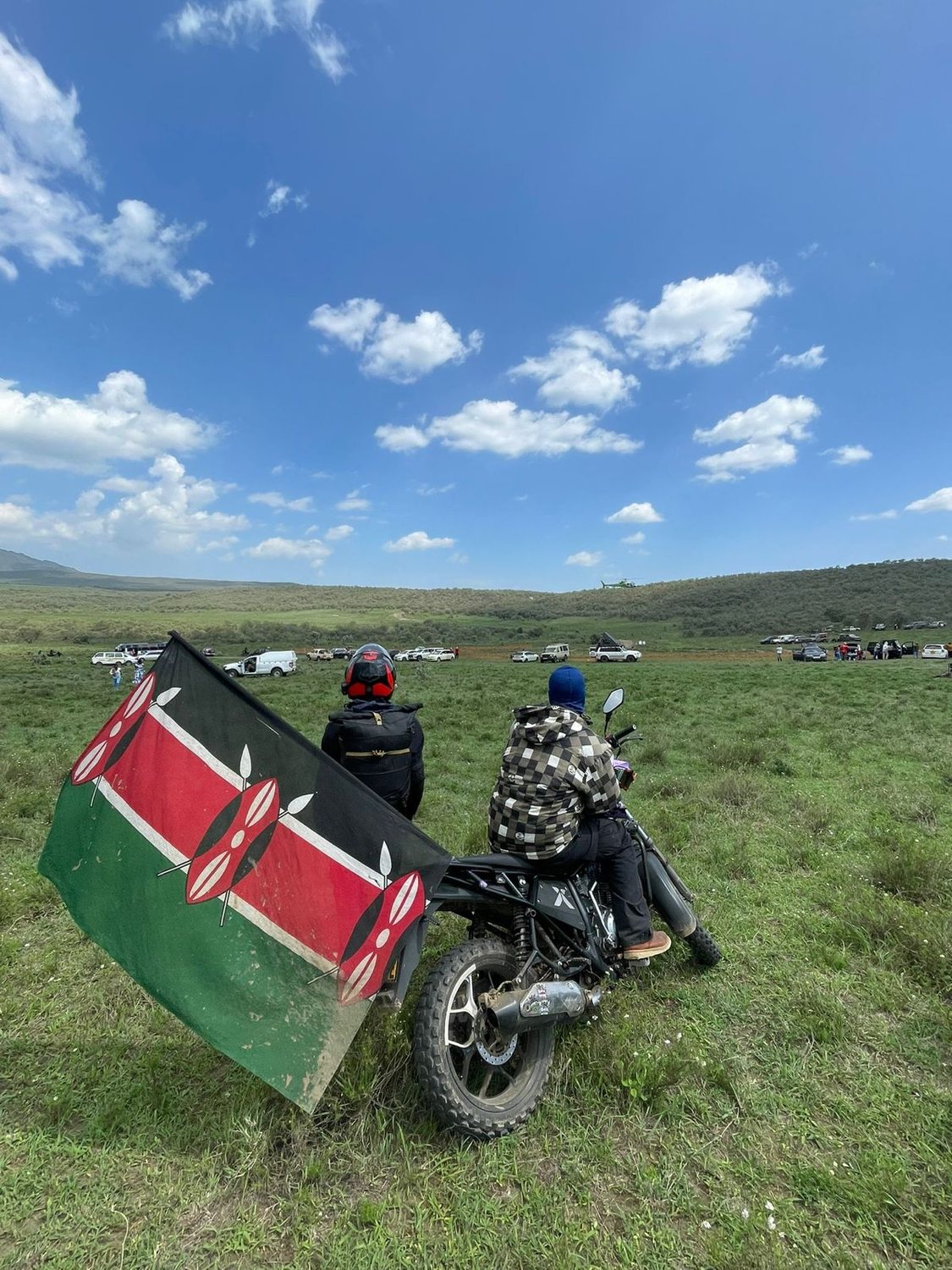
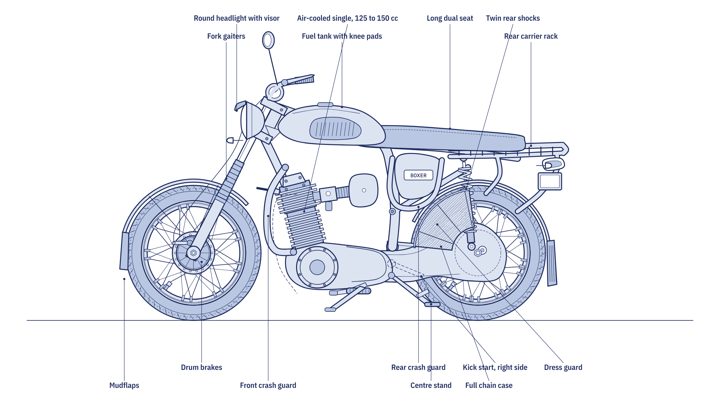
Most boda bodas are rugged 100 to 150 cc air-cooled singles with drum brakes, spoked wheels and a full chain case, such as the Bajaj Boxer and TVS HLX described in the boda boda type. The checks below suit those machines; electric bodas are covered at the end.
Daily checks before the first ride
This list follows the T-CLOCS pre-ride check (tyres, controls, lights, oil, chassis, stands) and takes about five minutes.
Tyres and wheels
- Look at both tyres for cuts, bulges, nails and objects in the tread. Spin each wheel and look along the rim for dents.
- Press each tyre with your thumb. If one feels softer than usual, check it with a gauge before riding.
- Run a hand over the spokes. A loose spoke rings dull when tapped and should be tightened before it breaks.
Controls and brakes
- Squeeze the front brake lever and press the rear pedal. Each should feel firm and stop well short of its limit. On many commuters the rear pedal has 20 to 30 mm of free play before the brake bites.
- Twist the throttle and let go in every handlebar position, from full left lock to full right lock. It must snap shut every time.
- Pull the clutch lever and check the cable moves freely, with no fraying at the ends.
Lights and electrics
- Check the headlight on dipped and main beam, the tail light, the brake light from both the lever and the pedal, the indicators and the horn.
- If the starter turns slowly in the morning, the battery or its terminals need attention before the bike leaves you stranded. Our guide to a battery that keeps going flat explains the tests.
Oil and leaks
- Check the engine oil level with the motorcycle upright on level ground. On many engines, including the K-Light 125, the dipstick is read resting in the hole, not screwed in.
- Look under the motorcycle for fresh drips of oil or fuel.
Chain, chassis and stands
- Push the chain up and down at the middle of the lower run. On many commuters the total movement should be 20 to 40 mm. Our chain maintenance guide explains how to measure and adjust it.
- Check that the centre stand and side stand spring back fully, and that the rear carrier and crash guards are tight.
Weekly checks
- Tyre pressures. Set them cold with a gauge, to the figure for the load you carry. The K-Light 125's solo figures are 190 kPa (27.5 psi) front and 210 kPa (30.5 psi) rear; manuals give higher figures for a passenger and load. Under-inflation makes a loaded tyre overheat and wear its shoulders. Our tyre pressure and wear guide has the details.
- Tread. Replace a tyre when the tread is level with the wear indicator bars in the grooves, at about 1 mm. Check the four-digit date code on the sidewall too: 2324 means week 23 of 2024.
- Chain. Clean and lubricate it. The usual interval of 500 to 800 km means at least once a week at 120 km a day, and more often after rain. Lubricate the inside of the lower run while the chain is warm.
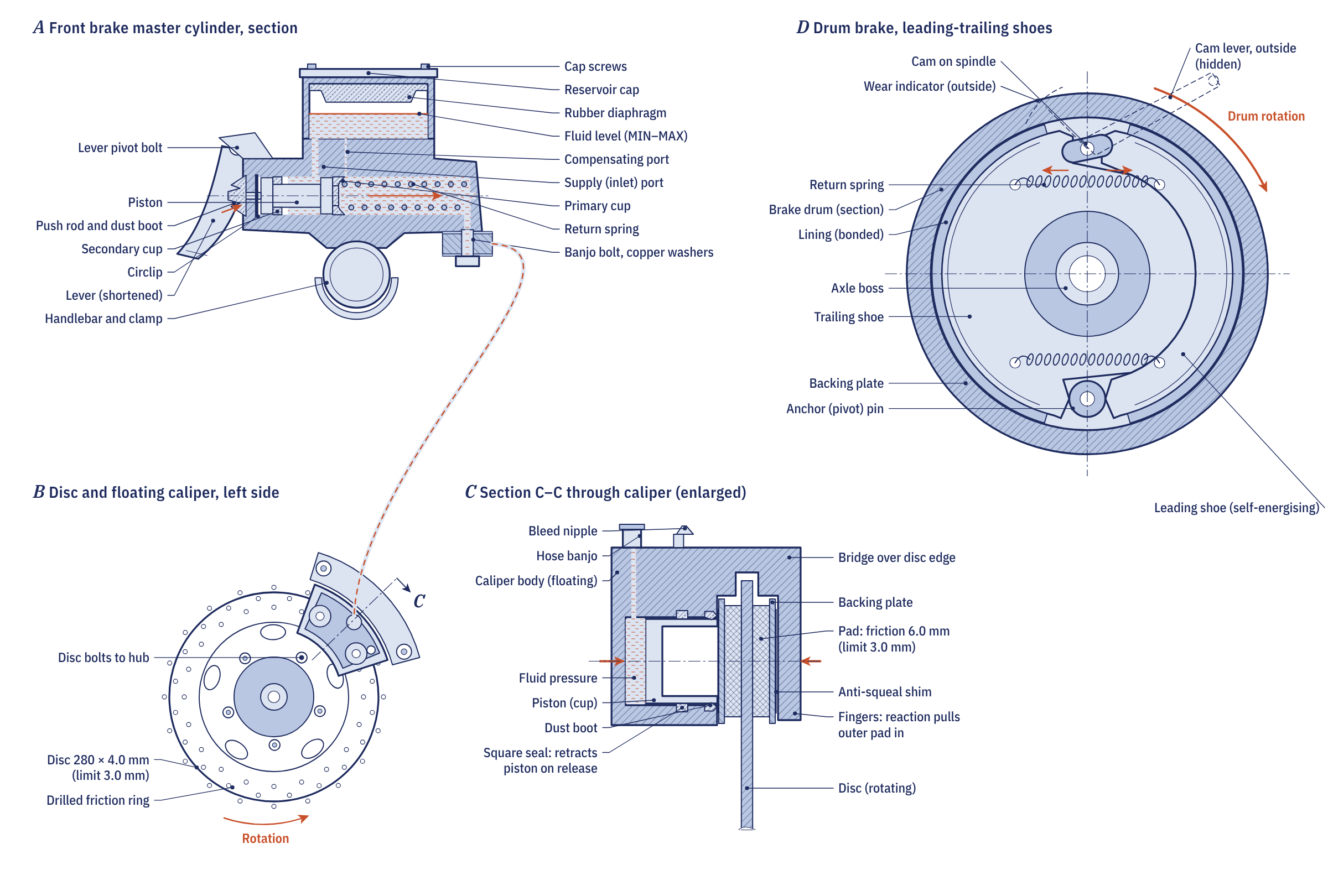
- Drum brake wear. Look at the wear indicator on the brake cam lever with the brake applied. If the pointer is beyond the mark, the shoes or the drum are worn out. On disc brakes, check the pads as described in our brake pad guide.
- Air filter. In the dry season, dust clogs the filter quickly and robs the engine of power and economy. Inspect it and clean or replace it as the manual directs, more often on dusty roads.
- Battery terminals. Check that both are tight and free of white or green corrosion. When removing a battery, disconnect the negative first and reconnect it last.
- Nuts and bolts. Check the axle nuts, the rear sprocket nuts, the engine mounts, the footpegs, the carrier and the mirrors. Vibration on rough roads loosens them.
Monthly or by distance
- Engine oil. The K-Light 125 changes its 1.1 litres of oil every 3,000 km, which at 120 km a day is less than a month. Use oil rated JASO MA or MA2, because the same oil lubricates the wet clutch; car oils with friction modifiers make it slip. Our guide to changing motorcycle oil gives the steps.
- Clutch free play. Set 10 to 15 mm at the lever tip on the K-Light 125, or the figure for your model. Our article on how a motorcycle clutch works explains why slip and drag follow from wrong free play.
- Chain wear and sprockets. Measure chain length over 10 or 20 links and look for hooked sprocket teeth. Replace chain and sprockets together.
- Spark plug, valve clearance and idle. Follow the manual's intervals, shortened for high mileage.
- Brake shoes. Remove the wheels, measure the linings (a typical limit is 1.5 to 2.0 mm), and clean the dust out with a damp cloth, never with compressed air. Grease the brake cam lightly with high-temperature grease.
- Charging check. With a multimeter across the battery and the engine at about 5,000 rpm, a healthy charging system reads within the specified window, typically 13.5 to 15.0 V. Our wiring basics guide explains the test.
Electric bodas
Electric boda bodas need no oil changes, spark plugs, valve adjustment or air filter. Tyres, brakes, wheel bearings and the chain or belt still need the same daily and weekly checks, and chains wear faster than on a petrol machine because of the motor's instant torque. Check the battery and charge connectors for looseness, burning or corrosion, and never open a traction battery or controller: packs above 60 V DC need trained technicians with insulated tools. Our guide to how electric motorcycles work explains the parts, and our battery care guide covers charging and storage.
The rider and passenger depend on the tyres and brakes more than on anything else. If a brake feels soft, a tyre is damaged or the chain is badly worn, fix it before carrying a passenger.
Chapter 4.8 of the course, Periodic maintenance and pre-delivery inspection, gives the full schedule, the T-CLOCS checklist and the chassis tune-up. When a check turns up a fault, the Repair section lists common problems with their causes, and has pages for the brakes, chain and rear wheel.
Frequently asked questions
How often should a boda boda have its oil changed?
Follow the manual and shorten the interval for heavy use. The K-Light 125 changes its oil every 3,000 km, which at 120 km a day is less than a month. Use JASO MA or MA2 oil.
How often should I oil my motorcycle chain?
Every 500 to 800 km and after rain. For a rider covering 120 km a day that means at least once a week.
What should I check on my motorcycle every day?
Tyres and wheels, brakes, throttle and clutch, lights and horn, engine oil level and leaks, chain slack and the stands. This is the T-CLOCS pre-ride check.
Do electric boda bodas need maintenance?
Yes, but less. They need no oil, spark plugs or air filter, but tyres, brakes, bearings, the chain or belt and the connectors still need regular checks.
Written by Transitions Lab for the Moto Zero open motorcycle course. Text and illustrations are licensed CC BY-SA 4.0. Figures and values come from the course modules; see sources and credits.