
Why motorcycle oil matters more than car oil
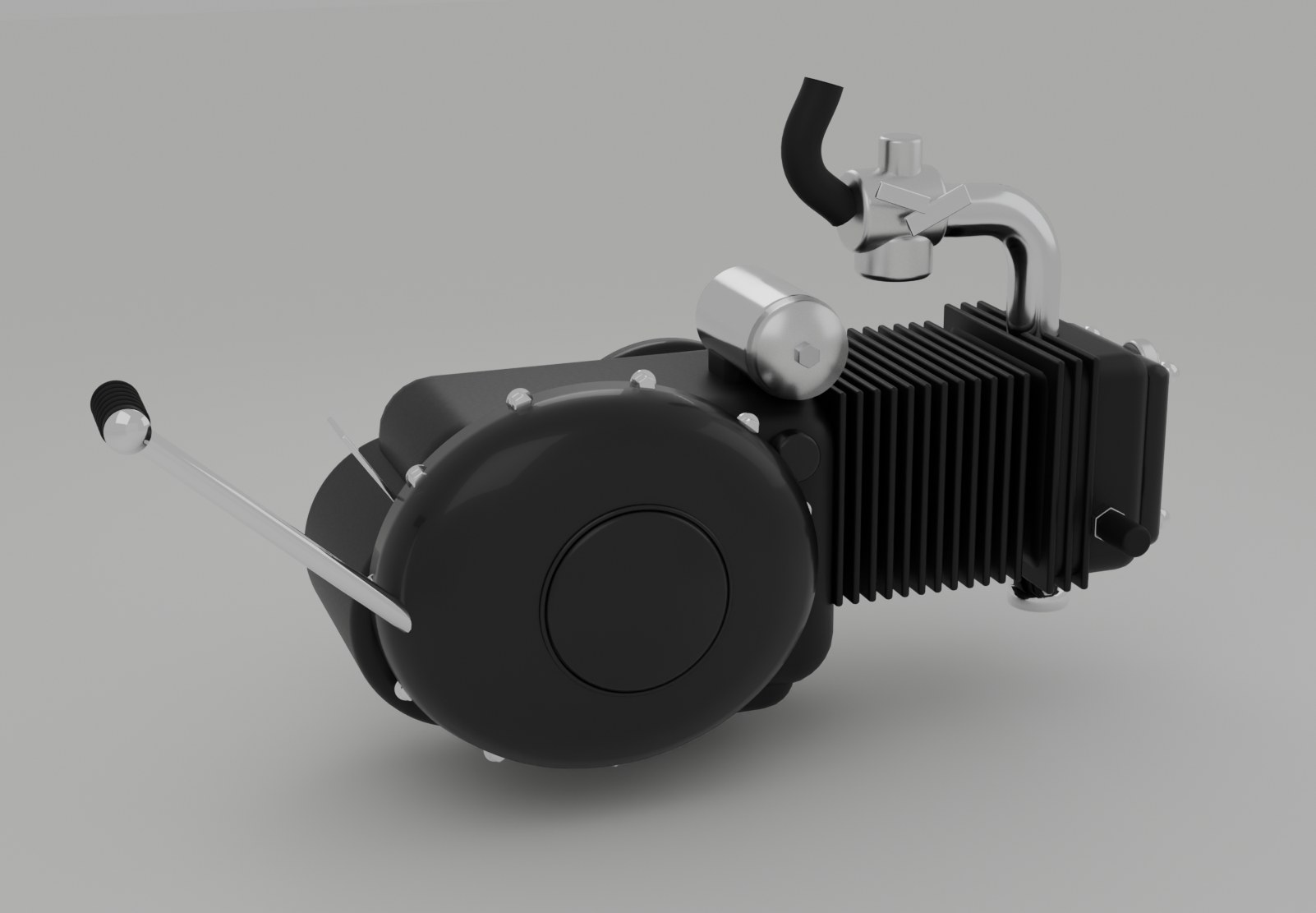
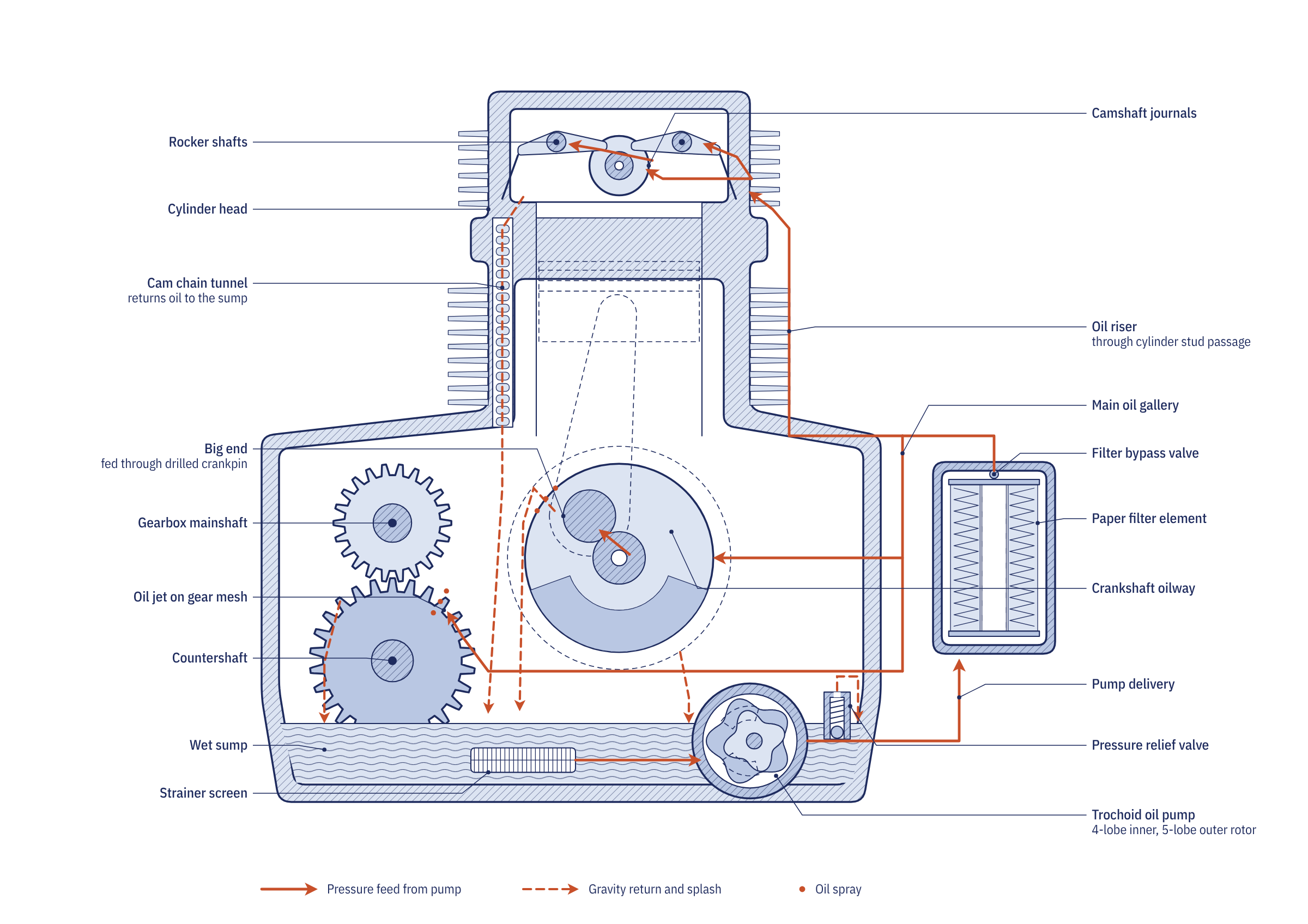
In a wet sump engine the oil is stored in the bottom of the crankcase, which on most motorcycles also houses the gearbox and the clutch, so one oil serves all three. It lubricates the crankshaft bearings and the valve gear, carries away heat (on an air-cooled engine the oil can carry 20 to 30 per cent of the heat the engine rejects), and must also let the clutch plates grip. That last job is why the grade matters as much as the change interval.
Which oil to buy
Two labels on the bottle matter. The SAE viscosity grade, such as 10W-40, describes how the oil behaves cold (the number before the W) and hot (the number after it, measured at 100 °C). Typical motorcycle grades are 10W-30, 10W-40 and 15W-50; use the one in your handbook.
The JASO rating describes how the oil treats a wet clutch. Car oils marked as energy conserving contain friction modifiers that make a wet clutch slip, so a motorcycle with a wet clutch needs oil rated JASO MA, MA1 or MA2. JASO MB is a low-friction oil for scooters with a dry centrifugal clutch and must not be used in a wet clutch. If a clutch starts to slip straight after an oil change, the course's first advice is to change back to a JASO MA oil before dismantling anything; our guide to how a motorcycle clutch works explains why.
How often to change it
Follow the maintenance schedule in your handbook, by distance or by time, whichever comes first, because oil ages even when the bike is parked. The K-Light 125, the commuter single used throughout the Moto Zero course, changes its oil every 3,000 km, with the first service at 300 km. Its schedule assumes about 1,000 km a month and asks for shorter intervals on dusty roads, at sustained high speed and at high mileage. Liquid-cooled multi-cylinder engines with paper filters typically go 6,000 to 12,000 km between changes.
A rider covering 6,000 km a year reaches the 3,000 km change every six months; a rider covering 500 km a year must still change the oil at the time limit in the schedule.
What you need
- The correct grade and quantity of oil: 1.1 ± 0.1 litres at an oil change on the K-Light 125, or the figure in your handbook.
- A spanner or socket for the drain plug, a drain pan large enough for the whole quantity, rags and gloves.
- A new sealing washer or O-ring for the drain plug if the manual specifies one, and a new filter if your engine uses a paper filter.
- A container to take the used oil to a collection point. Never pour it on the ground or into a drain.
Step by step
- Warm the engine. Warm oil flows out faster and carries more suspended dirt with it. Take care: the exhaust and the oil itself can burn.
- Position the bike. The K-Light 125 manual has the oil drained with the bike on its side stand, so that the drain point is low and the oil drains completely. Place the pan under the drain plug.
- Remove the drain plug. On the K-Light, as on the Honda CG125 family, a strainer screen and spring sit behind the drain plug and can pop out with it, so be ready to catch them.
- Let it drain fully, then clean the strainer screen and check that the screen, spring, drain plug and O-ring are intact before refitting.
- Deal with the filter. Small singles of the CG125 family use a centrifugal filter rotor on the crankshaft, which spins sludge to its outer wall and is cleaned at the intervals in the schedule (300, 6,000 and 12,000 km on the K-Light). Larger engines use a spin-on or cartridge paper filter that is replaced at the intervals in the handbook.
- Refit and tighten the drain plug to the torque in your manual. Overtightening strips the thread in the crankcase, which is far more expensive than the oil change.
- Fill with fresh oil through the filler, slightly under the full quantity at first.
- Run and recheck. Start the engine and let it idle for 2 to 3 minutes, stop it, wait a few minutes, and check the level.
- Check for leaks around the drain plug and filter.
Checking the level correctly
Check the level with the bike upright on level ground, not on the side stand. On a dipstick that screws into the filler, the K-Light manual has the dipstick rested in the hole, not screwed in, and the level read between the upper and lower marks. Top up to the upper mark if it is near the lower one.
Both too little and too much oil cause problems. Too little leads to overheating and serious wear. Too much can upset the running of the engine and the clutch, and an overfilled sump is listed among the causes of blue smoke.
Between changes, check the level weekly. An engine that steadily uses oil is telling you something: worn rings, valve guides or seals, or an external leak. The course's diagnosis chapter explains how to tell them apart.
Two-strokes, scooters and electric bikes
A two-stroke burns its lubricating oil with the fuel, mixed in the tank or injected by a pump, and keeps a separate gearbox oil that is changed on its own schedule. Scooters with a CVT and a dry centrifugal clutch can use JASO MB oil, because there is no oil-bathed clutch to slip. Electric motorcycles need no engine oil at all.
For other routine jobs, our daily, weekly and monthly maintenance checklist puts the oil change in context, and the clutch page in the Repair section covers slip after an oil change. Chapter 2.6 of the course, Lubrication and cooling, explains the oil pump, filters and the full JASO and SAE classifications.
Frequently asked questions
How often should I change my motorcycle oil?
Follow the handbook, by distance or time, whichever comes first. A small air-cooled single such as the K-Light 125 changes its oil every 3,000 km; liquid-cooled multis with paper filters typically go 6,000 to 12,000 km.
Can I use car oil in my motorcycle?
Not if the motorcycle has a wet clutch. Energy-conserving car oils contain friction modifiers that make the clutch slip. Use oil rated JASO MA, MA1 or MA2.
How much oil does a 125 cc motorcycle take?
It depends on the model. The K-Light 125 takes 1.1 ± 0.1 litres at an oil change and 1.2 ± 0.1 litres after an engine rebuild. Always check the handbook for your machine.
Should I check the oil level on the side stand?
No. Hold the bike upright on level ground, let the oil settle for a few minutes after running, and on a screw-in dipstick rest it in the hole without screwing it in.
Written by Transitions Lab for the Moto Zero open motorcycle course. Text and illustrations are licensed CC BY-SA 4.0. Figures and values come from the course modules; see sources and credits.