
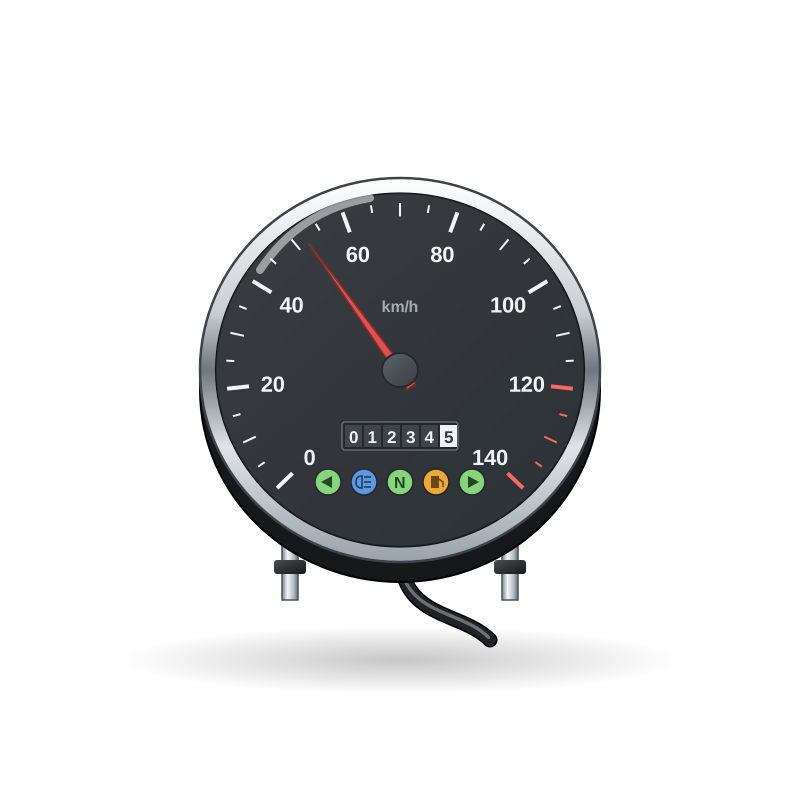
The instruments are the panel in front of the handlebar: speedometer, odometer, often a fuel gauge, rev counter and warning lamps for neutral, high beam, indicators, oil and the engine (MIL). Older bikes use a mechanical speedometer driven by a cable; newer ones use an electronic unit fed by a speed sensor.
What it does
The instruments tell you speed, distance, fuel and faults. Electronic clusters need a steady 12 V supply, an earth and signals from sensors and switches. Water getting in, vibration, a weak battery or a poor plug make them reset, flicker or go dark. Mechanical speedometers fail when the cable or drive gear wears.
Signs it is worn or failing
- Instruments or dashboard are dead.
- Speedometer or odometer does not work.
- Warning lights flicker or come on wrongly.
- Fuel gauge reads wrong.
- Fogged glass or water inside.
When to replace it
When it has power and earth at its plug and the sensor signals are good, but still does not work; or the case is broken and lets water in. Some parts (bulbs, glass) can be replaced alone.
What to match when buying
- Match make, model and year, plug and wiring. Speedometers are calibrated for wheel size and sensor; a wrong one reads wrong.
- In many countries changing the odometer reading is illegal. Keep a record of the old reading when fitting a new unit.
- Mechanical clusters: match the cable fitting.
Fitting notes
- Home job: Check power to the instruments, then Check the speed sensor or Replace the speedometer cable.
- Key off before unplugging. Fit the rubber mounts so vibration does not reach the unit.
Reference (K-Light 125)
| Item | Value | PDF page |
|---|---|---|
| Meter holder screw | 10 to 12 N·m | 101 |