
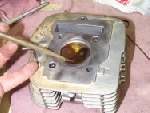
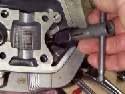
After a valve job or when a head is off, this test shows whether each valve seals on its seat. The cylinder head is turned so the combustion chamber is level, filled with solvent and left. Any liquid that seeps past a valve shows in the port.
Safety
- Solvent and petrol are flammable and harmful to breathe. Work outside or with good airflow. No sparks, no smoking.
- Do not pour more than is needed. Catch the drips and dispose of them properly.
- Wear gloves and eye protection.
You need
- The cylinder head with valves, springs and keepers fitted, off the engine.
- A clean container of solvent. Kerosene or mineral spirits work. Petrol is a fire risk.
- A torch and a flat, level surface.
- A clean, dry bench and rags.
Steps
- Clean the head, the ports and the combustion chamber. Make sure no valve is held up by a stuck keeper or spring.
- Fit the valves, springs, caps and keepers. Check that each spring sits on its washer (spring seat) and does not rest on bare aluminium.
- Turn the head so the combustion chamber faces up and sits level. Prop it if needed.
- Pour solvent into the chamber until it covers the valve heads.
- Wait for a minute or two.
- Look into the intake port and the exhaust port with a torch. Look for wetness or dripping around the valve stems.
- Dry the ports, wait, and look again. The liquid must stay in the chamber. Even a slow seep means a leak.
- If a valve leaks, strip that valve again. Look for a pit, a burnt spot, carbon or a seat that is too wide or rough. Re-lap with fine lapping paste, working back and forth, lifting now and then. A good seat has an even matt band all around without lines. Do not spin a valve in a drill.
- Clean every trace of paste. Refit the valve and test again.
- When the engine is assembled, clean the intake manifold, carburettor throat and air cleaner tube. A piece of dirt in a seat will stop the new valve sealing.
Check your work
- No liquid reaches the ports after the wait.
- Valve stems slide freely in the guide with only a little play. Excess play needs a new guide and a workshop.
- Valve springs measured against the manual's free length. A spring that has settled short should be replaced.
If it did not fix the problem
- Compression is still low after assembly: Low compression.
- Valve clearance too small can hold the valve open: Check and adjust valve clearance.
- A full top-end check: Assess the top end (cylinder, piston, valves).