
A fuel fault can feel exactly like an ignition fault. The difference is the spark. If a flash appears at the moment of every misfire, the spark is firing and the fault is in fuel or air. If the flash stops at the moment of the misfire, the fault is in ignition.
Safety
- Do this on a quiet road or private ground. Never look at the light instead of the road.
- Fix the light so it cannot fall into the wheel or onto the chain.
- Keep leads clear of the chain, exhaust and the steering.
- A helper on a following bike or in a car is safer than riding and watching alone.
You need
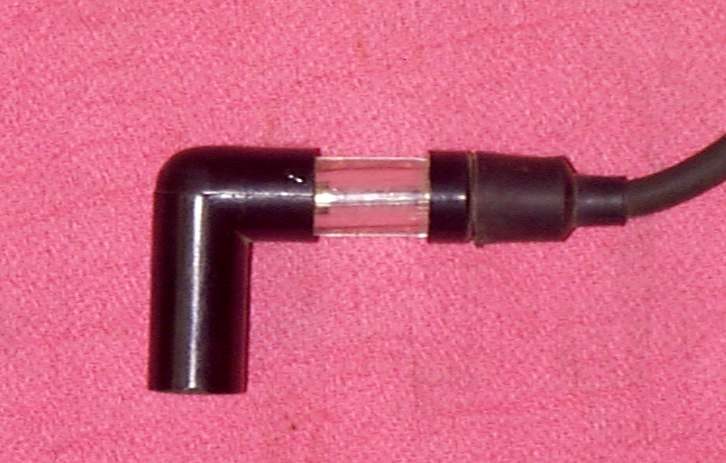
- A timing light that does not need the battery, or a plug cap with a lamp in it. A strobe that clips on the plug lead also works.
- Tape or ties to fix it where you can see it.
Steps
- Clip the light on the plug lead for the cylinder that misfires. Check it flashes steadily with the engine running at idle.
- Fix the light on the handlebar or tank where you can see the flash without moving your head. Aim it so you can see it in daylight, or ride at dusk.
- Ride at the speed and load where the misfire happens. Part throttle under load is the usual place.
- Watch the light when the engine misses.
- Flash is steady and bright at the moment of the miss: the spark is fine. Go to fuel and air: Misfire: ignition or fuel?.
- Flash drops out or goes dim at the miss: the ignition is cutting out. Go to Test the ignition coil and plug cap and Test the ignition pick-up.
- Repeat on the other cylinder if the bike has two. Only one plug may be at fault.
Check your work
- You saw the light at least three misfires and each one gave the same answer.
- You noted when it happened: hot or cold, load, rpm.
If it did not fix the problem
- Ignition result: Weak, thin or orange spark or Ignition cuts out when hot.
- Fuel result: Check the fuel tap, lines and flow and Clean the carburettor.