
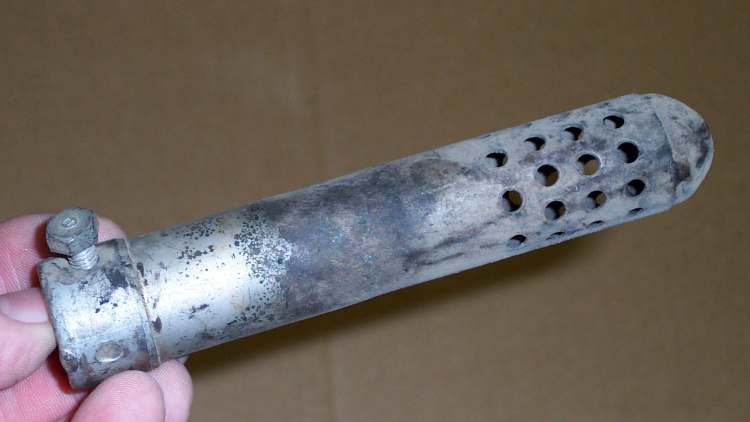
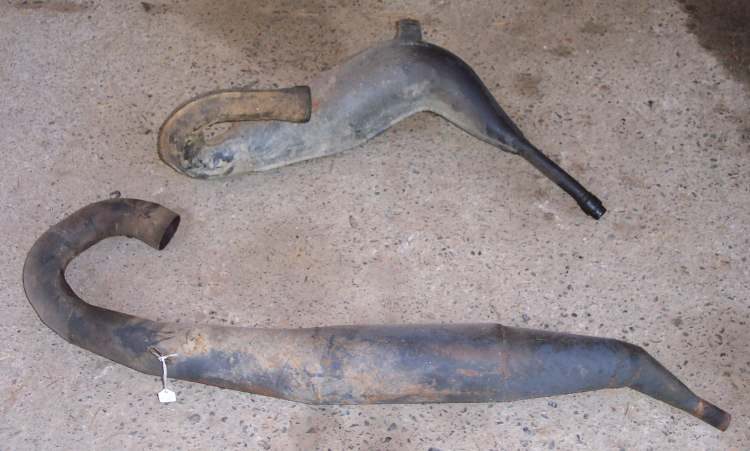
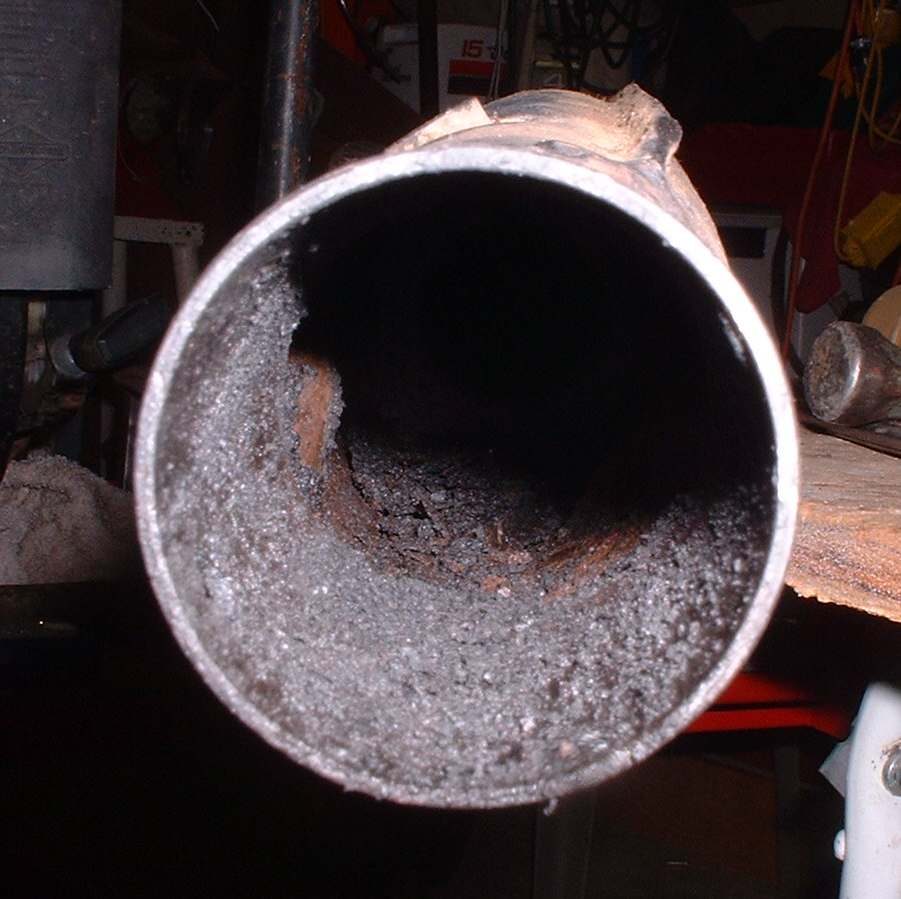
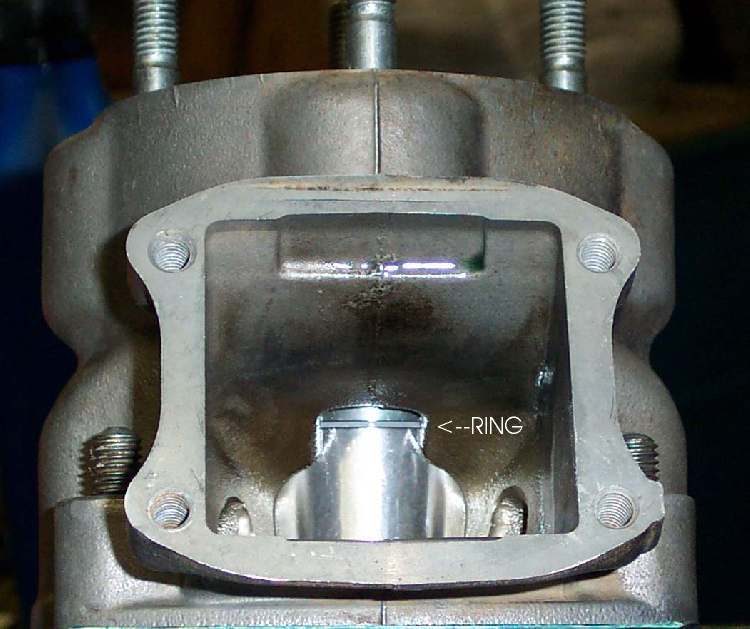
A two-stroke burns oil with its fuel, and the oil leaves carbon and sticky sludge in the exhaust port, the expansion chamber (the fat pipe that helps the engine breathe) and the silencer. Slowly the passages narrow. The engine loses top-end power, revs less freely, runs hotter and may "four-stroke" (fire every other turn) with a burbling sound. The K-Light (four-stroke) charts also list carbon in the exhaust port and silencer as a cause of overheating, so the same idea applies to old four-strokes, but heavy choking is mainly a two-stroke problem.
Is it safe to ride?
Yes with care. Avoid long hard runs: a choked engine runs hot and can seize.
Quick checks first
- Is the power loss slow over months, not sudden?
- Is the plug wet with oil or covered in black crust?
- Is there oil sludge dripping from the silencer joint or outlet?
- What oil and ratio are used: correct two-stroke oil, correct pump setting?
- If the baffle is removable or the silencer is packed with fibre, remove it, clean it and repack it first.
- Do not use caustic soda to dissolve carbon. It is dangerous. Burning out a pipe with a torch is also a skilled, outdoor job.
Diagnose it step by step
1Is the power loss sudden (one day fine, the next day weak)?
- Yes: a choked exhaust is unlikely. Go to Sudden loss of power while riding.
- No, gradual: go to step 2.
2Read the plug with Read a spark plug. Is it wet with oil or crusted black?
- Yes: too much oil is reaching the engine, or it is not burning cleanly. Go to step 3.
- No, light brown: go to step 4.
3Check the oil supply with Check the two-stroke oil pump and lines. Is the pump set too rich, or is the premix ratio too strong?
- Yes: correct it first, or the exhaust will choke again.
- No: go to step 4.
4Remove the silencer end cap or baffle if your model has one, and look inside with a torch. Is it caked with carbon or sludge?
- Yes: go to step 6.
- Cannot see: remove the header nuts (cold engine) and look into the exhaust port. Go to step 5.
5Is the exhaust port visibly narrowed by carbon?
- Yes: go to step 6.
- No: check compression with Test engine compression and see Engine feels weak and down on power.
6. Workshop: Decarbonise a two-stroke exhaust and port. The workshop cleans the exhaust and port, checks the piston and rings, and fits new gaskets.
What happens if you ignore it: power keeps falling, the engine overheats and the piston can seize. Sludge can also catch fire on a very hot pipe.
Causes, most likely first
| Cause | How to confirm | Fix |
|---|---|---|
| Normal carbon build-up over time | Gradual loss, crust inside | Decarbonise a two-stroke exhaust and port |
| Too much oil (pump or premix) | Wet plug, sludge | Check the two-stroke oil pump and lines |
| Wrong or poor oil | Heavy smoke, sticky deposits | Use oil to the maker's grade |
| Long slow riding | Short trips, low revs | Decoke at shorter intervals |