
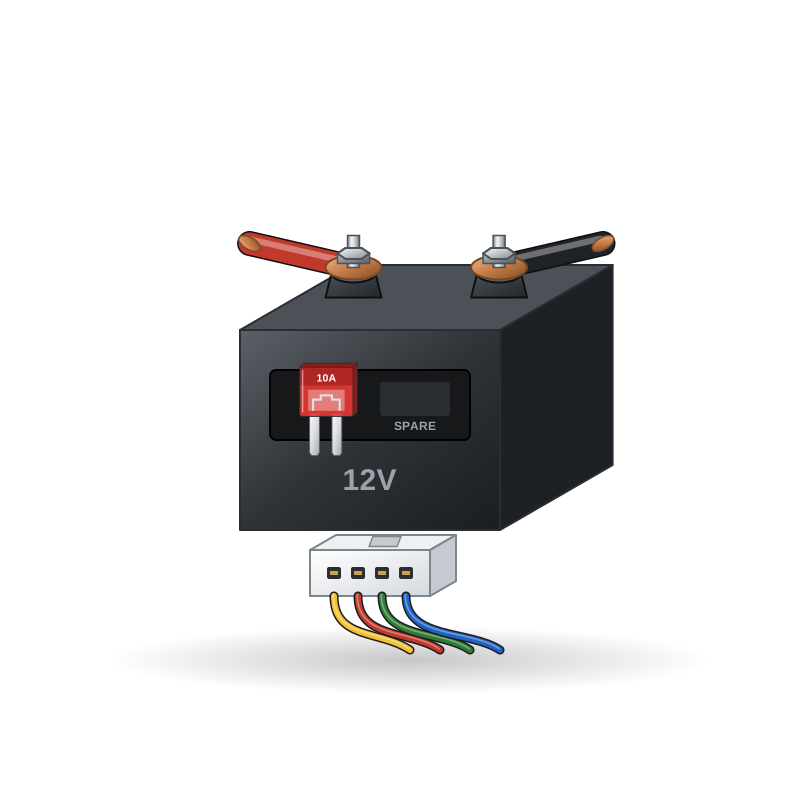
The starter relay is a small box, usually near the battery, with two large terminals for the thick battery and starter cables and a small plug for the start button circuit. On many bikes the main fuse sits in or beside it.
What it does
The start button can only carry a small current. Pressing it powers a coil in the relay, which pulls heavy contacts together and lets battery current flow to the starter motor. The coil's earth often goes through the clutch, neutral or side stand switches, so the starter only works when it is safe. The heavy contacts burn and pit with use; then the relay clicks but the motor does not turn.
Signs it is worn or failing
- Relay clicks but the engine does not turn.
- Nothing happens when I press the starter button.
- Starter keeps turning after I let go: contacts welded. Turn the key off and disconnect the battery.
- Hot or melted relay plug.
When to replace it
When the coil is open, or the main contacts do not close cleanly when 12 V is fed to the coil. Do not bridge the big terminals with a screwdriver to test; it makes large sparks near the battery.
What to match when buying
- Match the part number or make and model: plug shape, coil wires and any built-in fuse.
- Relays with the same case can have a different coil earth arrangement; match the wiring.
- Check the rubber boots and mounting are included.
Fitting notes
- Home job: Test the starter relay. Disconnect the battery negative before removing the heavy cables.
- Tighten heavy terminals firmly and fit the covers; a loose terminal heats up.
- If the relay does not click at all, test the interlocks: Test the side stand, clutch and neutral switches.
Reference (K-Light 125)
| Item | Value | PDF page |
|---|---|---|
| Coil feed (green/yellow), key on, clutch pulled or neutral | battery voltage | 93 |
| Main contacts with 12 V on coil | 0 Ω (closed) | 94 |