
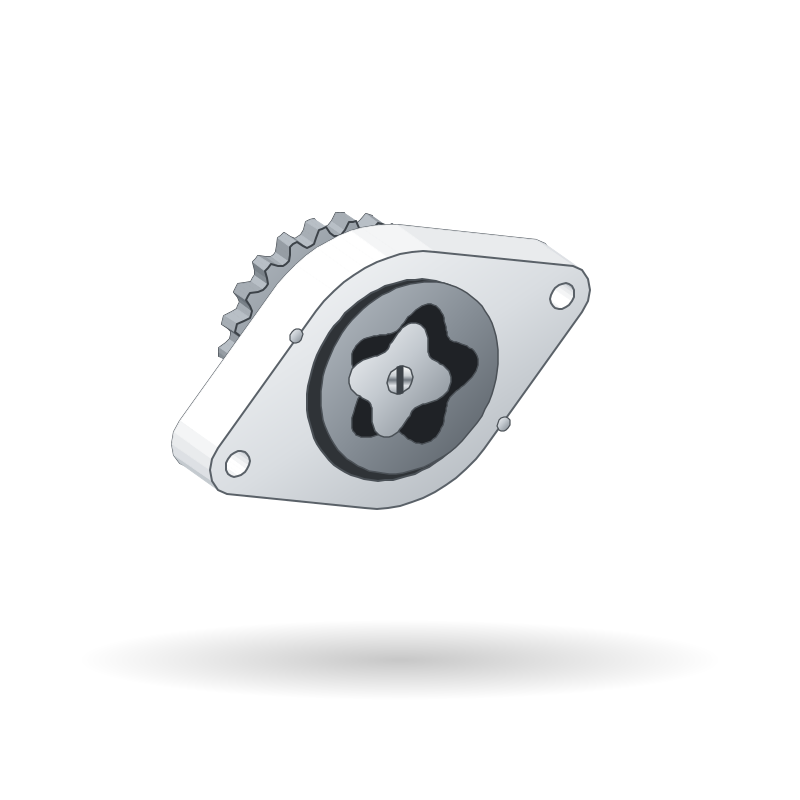
The oil pump is a small pump inside the engine, usually behind the right side cover, driven by the crankshaft. Most commuter four-strokes use a trochoid pump: an inner rotor turning inside an outer rotor. (The K-Light manual calls it a "fuel pump" by a translation error.) Two-stroke engines use a different part: the two-stroke oil pump.
What it does
The pump draws oil from the sump through the strainer and pushes it through the filter to the crank big end, then up a passage to the rocker arms or camshaft. Other parts get oil by splash. The rotors are very close fitting. Grit in dirty oil wears them, and a blocked strainer starves the pump.
Signs it is worn or failing
- Oil pressure or oil level light on with the level correct.
- Ticking from the top of the engine because oil is slow to reach the rockers.
- Engine overheats, then knocks or seizes.
- Pump failure is rare; check oil level, oil grade and the strainer first.
When to replace it
When rotor clearances are past the limit, the rotors are scored, or the drive gear is damaged. Follow your bike's manual.
What to match when buying
- Match engine code. Pumps for 100 cc and 125 cc engines of one family can differ in rotor width.
- Check the drive gear teeth and shaft against the old pump.
- A good pump turns freely by hand with no tight spots and has a clean, flat body face.
Fitting notes
- Workshop job. Keep every bit of grit out; flush and blow out the parts before fitting.
- Prime the pump with clean oil on assembly so it picks up at once.
- Fix the cause: clean the strainer and use the right oil at the right interval with Change the engine oil. See Assess bottom end.
Reference (K-Light 125)
| Item | Value | PDF page |
|---|---|---|
| Inner to outer rotor clearance | 0.10 to 0.15 mm, limit 0.25 mm | 196 |
| Outer rotor to body clearance | 0.10 to 0.15 mm, limit 0.25 mm | 196 |
| Rotor end clearance | 0.07 to 0.12 mm, limit 0.15 mm | 196 |