
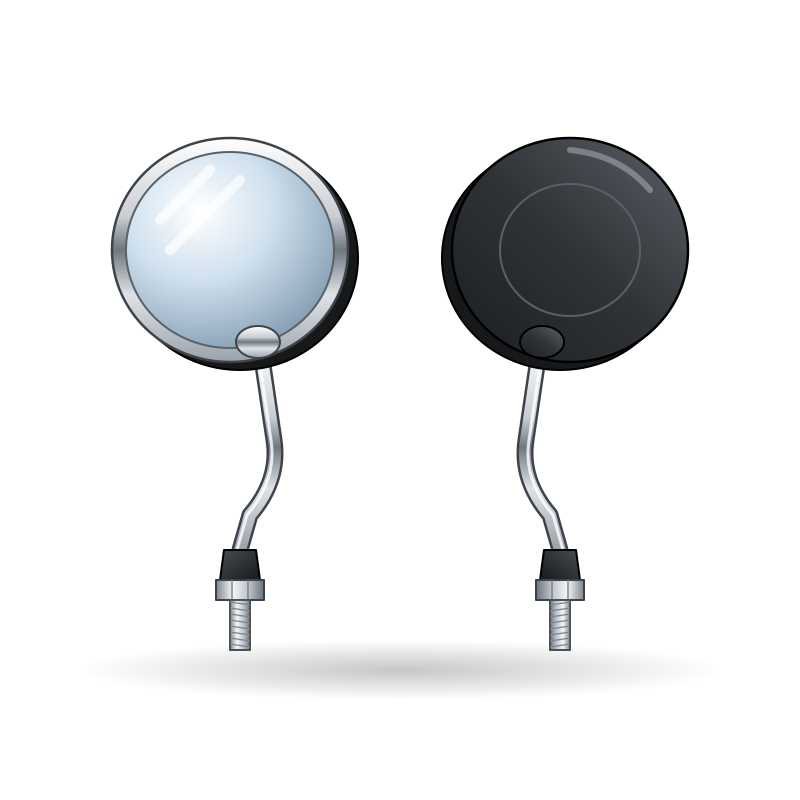
Mirrors are mounted on the handlebar, usually screwed into the lever brackets or a clamp, with a locknut at the base. On some scooters they mount on the body.
What it does
Mirrors let you see traffic behind you without turning your head. The arm has a ball joint or pivot so you can aim it. Vibration and knocks loosen the base nut or the joint, so the mirror turns while riding. Cracked glass distorts the view.
Signs it is worn or failing
- Mirror loose, droops or will not stay in place: Mirror is loose or will not stay in place.
- Blurred view at speed from vibration: Vibration at certain speeds.
- Cracked or missing glass.
When to replace it
Replace a mirror with cracked glass, a stripped thread or a joint that will not hold after tightening. In many countries, mirrors are required by law.
What to match when buying
- Thread size and direction: many bikes use 8 mm or 10 mm threads, and some have a left-hand thread on one side. Check the old mirror.
- Left and right are often different.
- Road-legal mirrors carry an approval mark (an "E" in a circle with a number in Europe and some other markets).
- Cheap mirrors may vibrate badly or have poor glass.
Fitting notes
- Hold the mirror stem with one spanner while you tighten the locknut with another.
- Aim so you see a little of your shoulder and the lane behind.
- See Tighten and adjust mirrors.
Reference (K-Light 125)
| Item | Value | PDF page |
|---|---|---|
| Mirror bolt (M8×50) | 22 to 29 N·m | 131 |
| Approval mark | E7 000501 | 49 |