
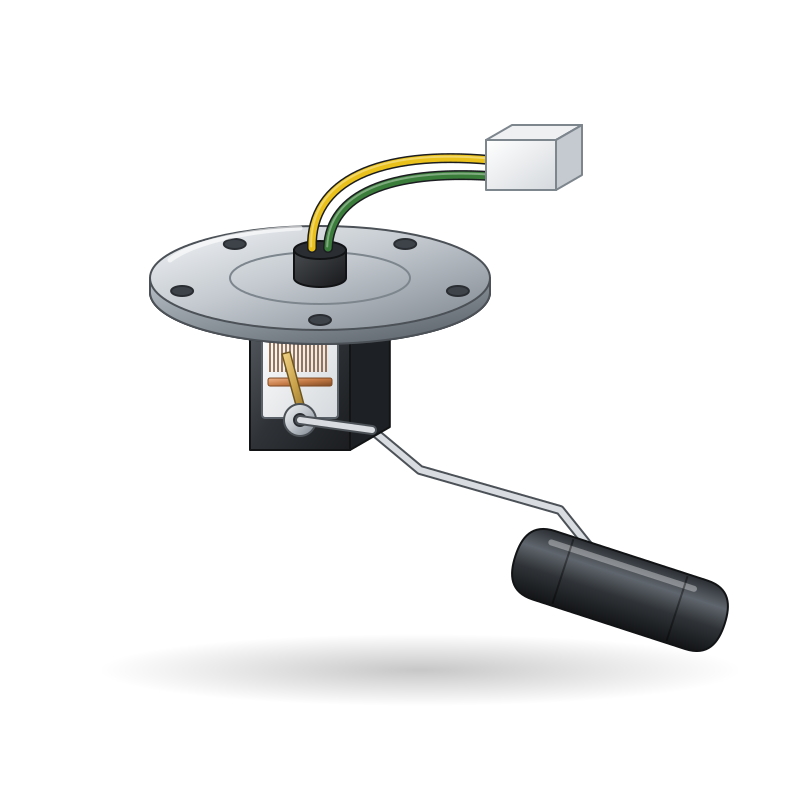
The fuel level sender is a float on an arm, fixed to the tank, that tells the fuel gauge how much fuel is left. On many fuel-injected bikes it is part of the pump unit; on the K-Light 125 it is a separate unit held by a nut with a rubber washer.
What it does
As the fuel level drops, the float sinks and moves a wiper along a resistor. The gauge reads the change in resistance and moves the needle or bars. Some bikes only have a low-fuel warning light, switched by a sensor at the bottom of the tank. Wear on the resistor track, a leaking float or dirt on the wiper makes the reading jump or stick.
Signs it is worn or failing
- Fuel gauge reads wrong or does not move.
- Gauge jumps when riding over bumps.
- Fuel leaking at the sender seal.
When to replace it
When the float has fuel inside, the arm is bent beyond repair, or the resistance does not change smoothly as the float moves. Check the gauge wiring and plug before replacing. Follow your bike's manual for the resistance values.
What to match when buying
- Match make, model and year. Senders differ in arm length, float shape and resistance range; a wrong one reads wrong all the time.
- Match the plug and the mounting (nut, ring or part of the pump).
- Buy a new rubber seal or washer with it.
Fitting notes
- Home job: Test the fuel level sender.
- Drain or nearly empty the tank, work outside, battery negative off.
- Fit the float arm without bending it. Tighten the nut evenly, then check for leaks with a full tank.
Reference (K-Light 125)
| Item | Value | PDF page |
|---|---|---|
| Sender fixing nut | 5 to 9 N·m | 180 |